
Quote Stories
A Rhythm for the Waiting Room
Amara discovers that a delayed journey can still move people somewhere.
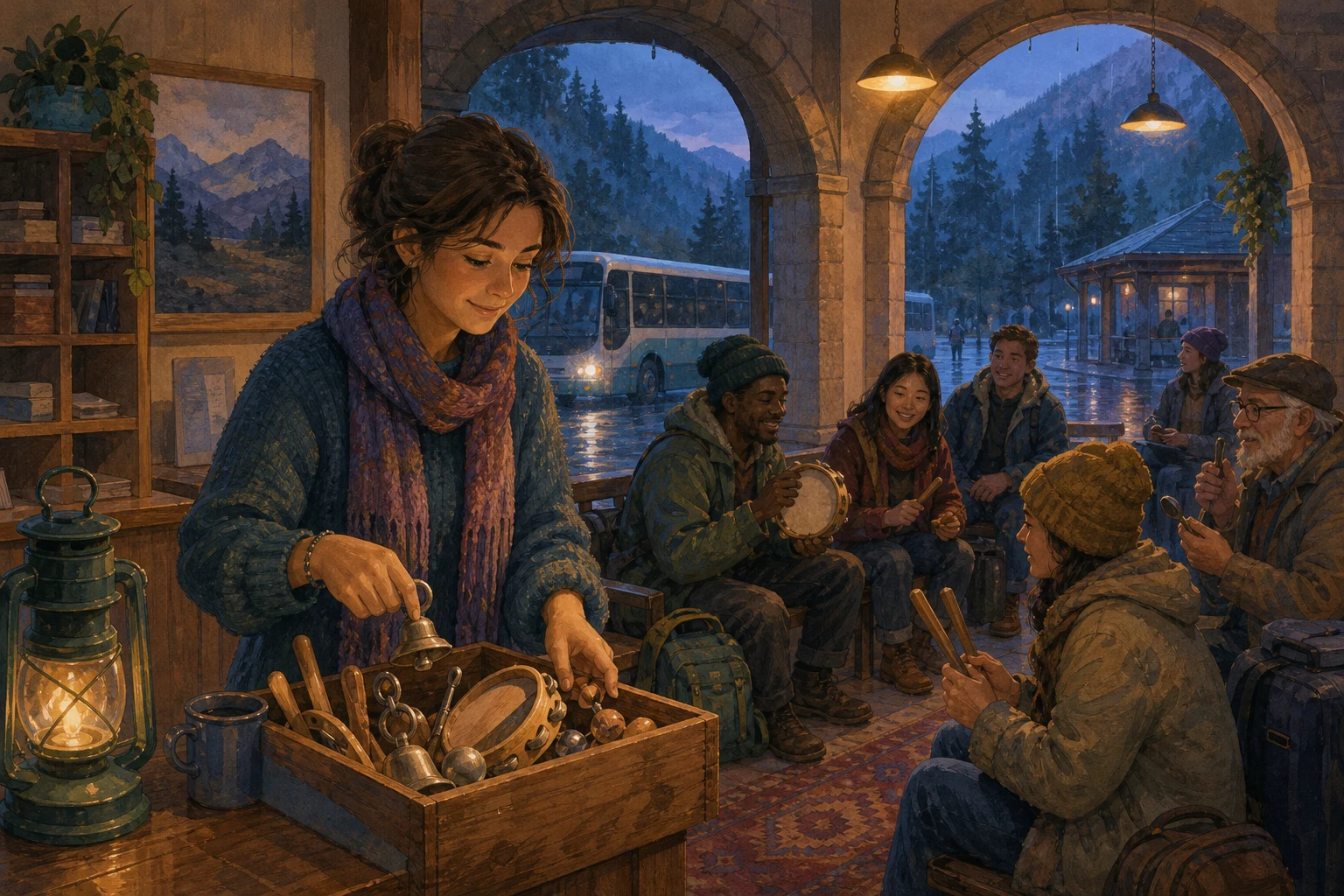
The rain had erased the road beyond the eastern checkpoint, and every bus on Amara’s departure board had become a red line.
By six o’clock, the waiting room was full of damp coats, steaming cups, and the particular silence of people trying not to look at the clock. A child tapped two fingers against a suitcase. An old man hummed three notes and stopped. Somewhere near the ticket window, a woman whistled the same unfinished phrase each time the loudspeaker crackled.
Amara noticed because noticing was part of her job. She knew which passengers needed a window seat, who had forgotten a passport, and who pretended not to be worried about missing a connection. Usually, she gave information and pointed toward the tea stall. That evening, she unlocked the lost-property cabinet and found a dented tin whistle, a pair of wooden shakers, and a small drum with one loose strap.
The next day she brought a box from home and labeled it: POCKET ORCHESTRA.
Inside were bells, rhythm sticks, a triangle, two tambourines, and spoons wrapped in cloth. She set it beneath the departure board with a handwritten note: TAKE ONE. RETURN IT WHEN YOU’RE DONE.
At first, the instruments made the waiting room brighter. A baker played the spoons against his knee. Two students invented a rhythm for the route numbers. Even Amara tapped the counter when she thought no one was watching.
Then the confident musicians took over.
A man with a polished flute gathered an audience around himself. Two drummers competed until the glass in the tea stall trembled. Beginners stopped reaching for the box. When a nervous traveler tried the triangle, someone laughed.
Amara shut the lid.
“Perhaps the orchestra is closed,” she said.
The flute player frowned. “Because some people know how to play?”
“No,” Amara replied. “Because some people have forgotten how to listen.”
She expected an argument. Instead, the woman who had been whistling stepped forward. “Could we try again without an audience?”
So Amara changed the arrangement. Each group would last five minutes. A beginner chose the rhythm. Experienced players could accompany, but no one could lead twice in a row. Anyone who preferred silence could simply sit nearby.
The first new group was awkward. A tired porter chose a rhythm that kept losing its way. The polished flute player followed too quickly and had to stop. A child with red mittens lifted one bell and rang it only once.
“Again,” said the woman with the unfinished whistle. “Let’s leave space for the bell.”
They tried. This time, the bell entered cleanly. The porter’s rhythm steadied. The flute softened around it.
Outside, rain streamed down the stone arcades. Inside, five strangers made something small enough to fit between two announcements.
Over the following weeks, Amara built a chart from scraps of ticket paper. Blue meant beginners chose first. Yellow meant no repeated instrument. Green meant the group would end with one minute of quiet. Travelers began adding their own rules. A mountain guide introduced a three-beat pattern used for calling goats. A university student taught everyone a rhythm for remembering a difficult alphabet. The tea seller contributed metal cups, provided nobody struck them too hard.
Not every evening went smoothly. Some passengers wanted a performance. Others wanted the room quiet. Once, two groups argued over the same tambourine until Amara placed it between them and announced that it would belong to whoever could pass it without interrupting the beat.
They managed it after seven attempts.
By the first clear evening of the season, the departure board showed only one delay. People still checked their watches. They still worried about roads and connections. But now, when a bus was late, someone opened the box.
Amara no longer stood behind the counter for every gathering. She watched from the doorway as newcomers were shown where to sit and regulars lowered their volume to make room. The waiting room had not become quieter. It had become more generous.
The final bus of the evening arrived beneath a sky washed clean of clouds. Passengers gathered their bags. The woman with the whistle returned the triangle to its place.
“Will there be music tomorrow?” she asked.
Amara looked at the box, then at the empty chairs already waiting for strangers.
“There will be room for it,” she said.
Related Quote Stories

Before the First Whistle
Nabil knew every lane by its depth, every tile by its crack, and every regular by the sound of their kick. What he did not know was how many people were waiting for a schedule that made room for them.
Read Story →
Bread Before Sunrise
After leaving a punishing hotel kitchen, Tomas expects his intricate pastries to speak for themselves. A night-shift cleaner helps him listen instead.
Read Story →
A Garden Tuned by Hand
When Safiya inherits a nearly silent bell workshop, she plans to sell its molds and move on. A teacher’s request—and a determined group of young testers—leads her toward a new kind of craft.
Read Story →