
Quote Stories
Ink for the Everyday
Sami learns that useful ideas begin with listening
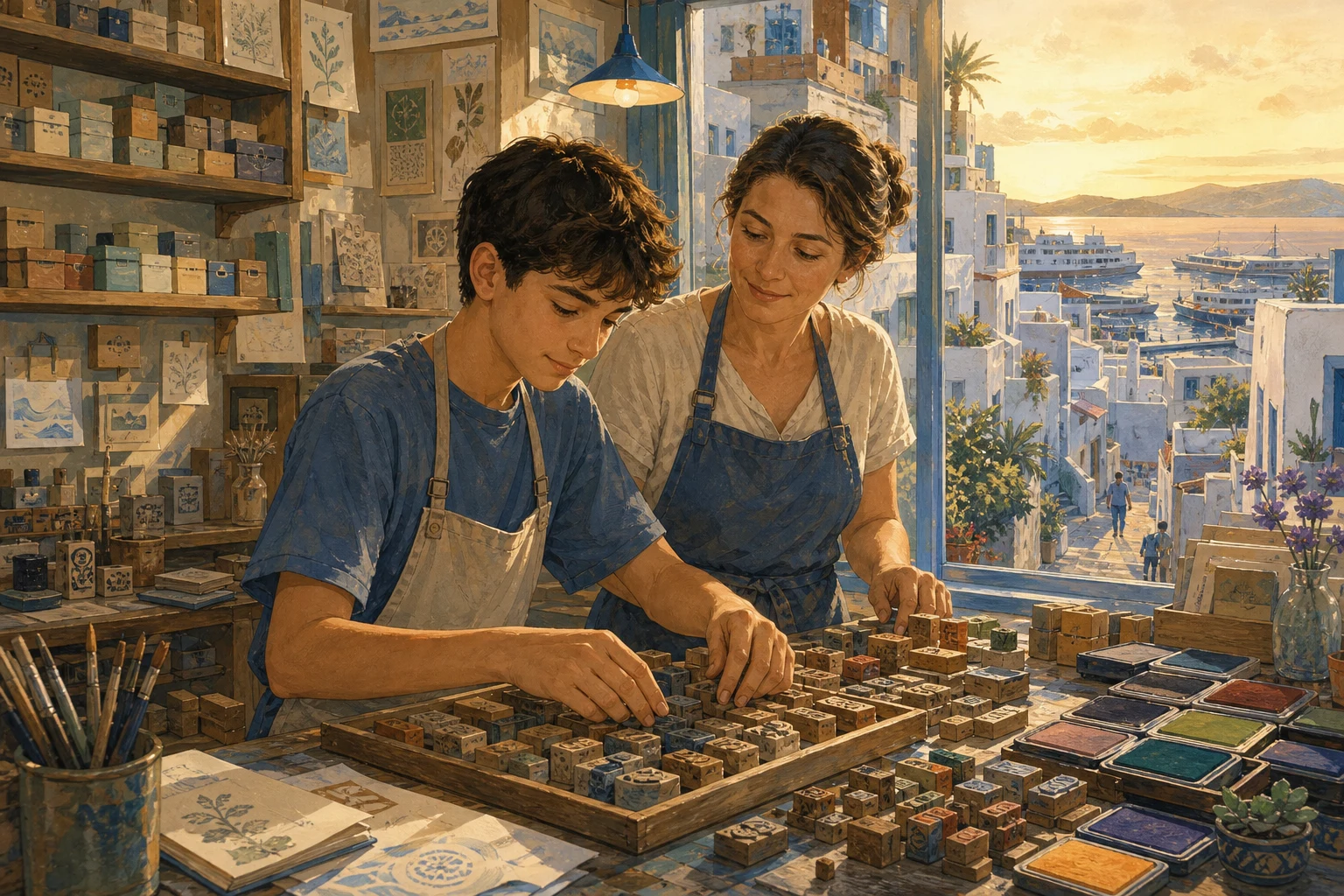
The first stamp Sami designed had twelve curling waves, a moon with a face, and a tiny sailing ship tucked inside the letter A.
His aunt pressed it into blue ink and tested it on a scrap of paper. The result was beautiful. It was also, as far as anyone could tell, useless.
“Who is this for?” Aunt Laleh asked.
“Someone who wants it.”
“Someone specific?”
Sami looked toward the window. Beyond the glass, steep white streets fell toward the ferry docks, where cranes lifted crates beneath strings of laundry. “Not yet.”
For three weeks, he filled the shop with inventions for customers who did not exist: a compass stamp for adventurous notebooks, a dramatic dragon for letters, and an elaborate seal with a crown, though nobody in the neighborhood had requested a crown.
The shop’s real orders grew fewer. People could upload a design and have hundreds of labels delivered before Aunt Laleh had finished cleaning the rubber scraps from the cutting table.
One afternoon, a baker named Rima hurried in carrying a jar.
“Can you make a stamp that says ‘orange peel’?” she asked. “Small enough for this lid, and cheap enough that I can order many.”
Sami almost showed her the dragon. Instead, he measured the lid.
The next morning, a gardener needed seed envelopes marked “beans,” “basil,” and “save for spring.” That afternoon, a theater group wanted simple stamps to sort props: lantern, letter, chair, crown.
Sami noticed that everyone apologized for their requests, as if ordinary needs were not worth designing for.
At closing, he spread the orders across the counter. They were plain, practical, and suddenly more interesting than his imaginary masterpieces.
“What if we made a catalog?” he said. “Useful stamps. Affordable ones. People could choose a size, a word, and a picture.”
Aunt Laleh studied the papers. “And who will draw all those pictures?”
Sami glanced at the crowded streets outside. “People who already know what they need.”
He began asking questions. The baker chose a loaf, a jar, and a sun. The gardener suggested leaves that could be carved quickly. The theater group tested symbols until even a nervous new stagehand could sort the props without asking twice.
Sami invited local makers to contribute designs in exchange for a share of each order. A sign painter drew bold letters. A retired sailor created tiny harbor symbols. A schoolchild invented a stamp shaped like a sock for marking laundry bags.
The catalog grew from one page to six. It was called Small Orders, because Aunt Laleh said a modest request still deserved careful work.
Customers began lingering in the shop. They brought sketches on envelopes, questions about ink, and ideas that changed while Sami listened. The online services were faster, but they could not ask whether the seed envelopes would get wet, or whether a theater prop needed to be recognized from the back row.
By the end of the season, the shop was busy—not with grand commissions, but with dozens of small ones. A ferry cook ordered labels for spice tins. A music teacher marked instrument cases. A rooftop beekeeper requested a warning symbol that children could understand.
One evening, Sami found his first twelve-wave stamp beneath a stack of envelopes. He pressed it onto the cover of the new catalog. The sailing ship landed beside a list of useful designs, no longer waiting for an imaginary customer.
Aunt Laleh locked the door and handed him the key for the morning.
“Your shop,” she said.
Sami looked at the shelves of ink, carved rubber, and unfinished ideas. “Ours,” he replied.
Then he turned off the light, leaving the catalog open on the counter to the page where anyone could begin.
Related Quote Stories

A Bell for Every Hollow
Tavi’s first bell could be heard from three valleys away. That was precisely the problem.
Read Story →
When the Trays Went Still
Suri had always believed a good bakery sounded busy. Then a new apprentice showed her how much skill could be hidden inside the noise.
Read Story →
Wind Has a Way of Answering
After a crosswind tears apart her contest kite, Mara stops decorating and starts listening—to the wind, to an old weather watcher, and to the children whose kites fail beside hers.
Read Story →