
Quote Stories
Rain Finds Every Loose Wire
Celia learns that keeping a path bright takes more than replacing bulbs.
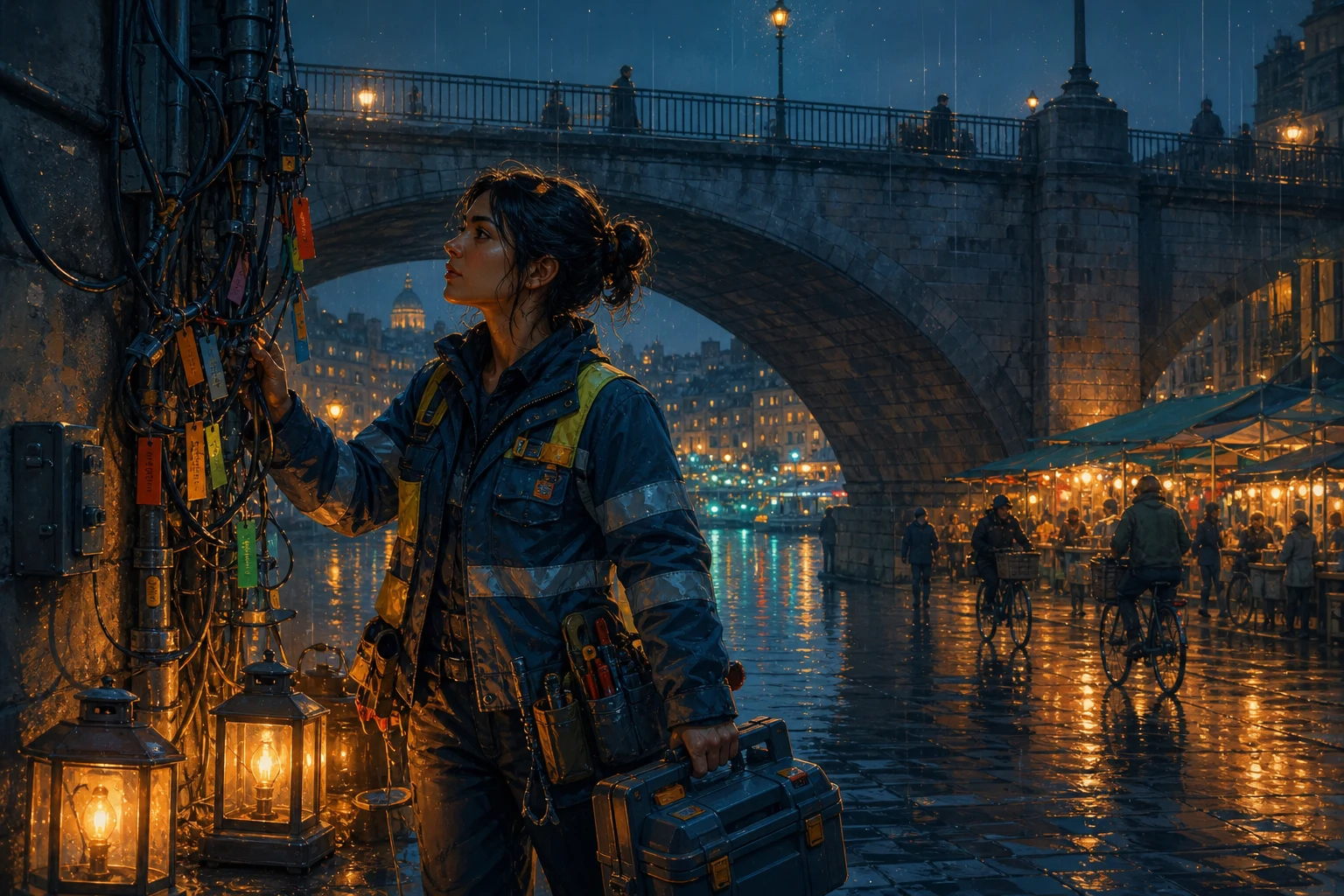
Celia trusted electricity because it obeyed rules. Rain, unfortunately, kept changing them.
At 1:13 a.m., beneath the old stone bridge, she crouched beside a dead lantern while warm water slid from her helmet onto her hands. Across the river, apartment windows trembled with reflected lightning. A vendor was packing up his cart. Two cyclists turned back.
Celia opened the metal box, tightened a connection, and replaced the blown bulb. The path brightened in a clean amber line.
“See?” she muttered. “Simple.”
By the time she reached the far end of the walkway, the lantern behind her had gone dark again.
The next night, she returned with better bulbs. The night after that, she brought heavier tape. Each repair lasted just long enough to make her believe she had won.
Then, during a hard afternoon storm, Celia found three colored threads of temporary wire sagging between the bridge pillars. One had slipped from its clip. Another was rubbing against a sharp bracket. The lamps were not failing because they were weak. They were failing because no one was checking the whole line.
At the evening market, she laid a hand-drawn diagram on the counter of a juice seller named Inés.
“I need people who use the path,” Celia said. “Not electricians. Witnesses.”
Inés studied the diagram. “Witnesses do what?”
“Notice things before they become emergencies.”
The first meeting drew six people: Inés, two cyclists, a student who walked home from the late library, a guard from the riverside stalls, and an elderly man who knew every cracked paving stone. Celia explained her plan. Each volunteer would inspect one section twice a week and attach a colored tag when something needed attention: blue for a loose cover, yellow for a flickering lamp, red for exposed wiring or a blocked drain.
The group liked the colors. They did not like Celia’s first schedule.
“You assigned everyone the section nearest their homes,” said the student. “That gives some of us the steep stairs every time.”
Celia looked at her neat chart. It had seemed efficient. It had not seemed fair.
They redrew it together, adding paired walks and a simple rule: no one inspected alone after heavy rain. The cyclists offered spare lights. Inés kept tags in a dry tin beneath her register. The guard marked the bridge pillars with small numbers so problems could be reported without confusion.
Still, the path went dark twice more.
The first time, a tag fell into the river. The second time, volunteers reported a broken lamp but forgot to check the drain beside it. Celia felt irritation rise like heat beneath her collar.
“You see?” she said. “This is why I do it myself.”
The elderly man, whose name was Tomás, pointed toward the bridge. “And how many paths can you walk at once?”
Celia had no answer.
They changed the system again. Every inspection ended with a message to the next pair. Every red tag required a photograph and a second set of eyes. Celia taught the volunteers how to shut off the temporary circuit safely, and the volunteers taught her which corners stayed muddy, which vendors closed late, and where people hesitated when the lights failed.
Weeks passed. The colored tags began appearing less often. A yellow tag would be replaced by a blue one, then disappear. The path still bore patched cables and weather-stained fixtures, but its care was no longer invisible or solitary.
One evening, a municipal crew arrived with permanent conduit, sealed junction boxes, and a budget large enough to repair the entire walkway. Celia expected to feel triumphant. Instead, she felt oddly protective of the old tags in Inés’s tin.
“Will the group stop now?” the student asked.
“Only if you want it to,” Celia said.
They kept walking. Their inspections became monthly rather than nightly. They added a brush for clearing leaves from the drains and a small bench beneath the brightest lantern, where tired vendors could rest before carrying their crates home.
On the first night the permanent lights came on, rain began tapping against the bridge. Celia stood at the center of the path while the lamps awakened one after another, steady and gold. Cyclists passed without turning back. Inés handed out cups of hot cinnamon tea. Tomás tested the bench with great seriousness.
Celia looked down the illuminated walkway. The light no longer felt like something she had supplied. It felt like something everyone had learned to keep.
She clipped the final red tag into the empty tin and closed the lid.
Related Quote Stories
What Each Pot Knows
Eleni’s first plant labels contain everything except what her customers need. To fix them, she asks the island’s gardeners, cooks, and children to share what they know.
Read Story →
A Table with No Original Shape
Oren trusted wood because it never pretended to be undamaged. But when a cracked table arrives from the youth shelter with half its pieces missing, restoration becomes a question no chisel can answer alone.
Read Story →
Before the First Whistle
Nabil knew every lane by its depth, every tile by its crack, and every regular by the sound of their kick. What he did not know was how many people were waiting for a schedule that made room for them.
Read Story →