
Quote Stories
The Map Inside the Rain Barrel
A careful look at water teaches one student how to be heard
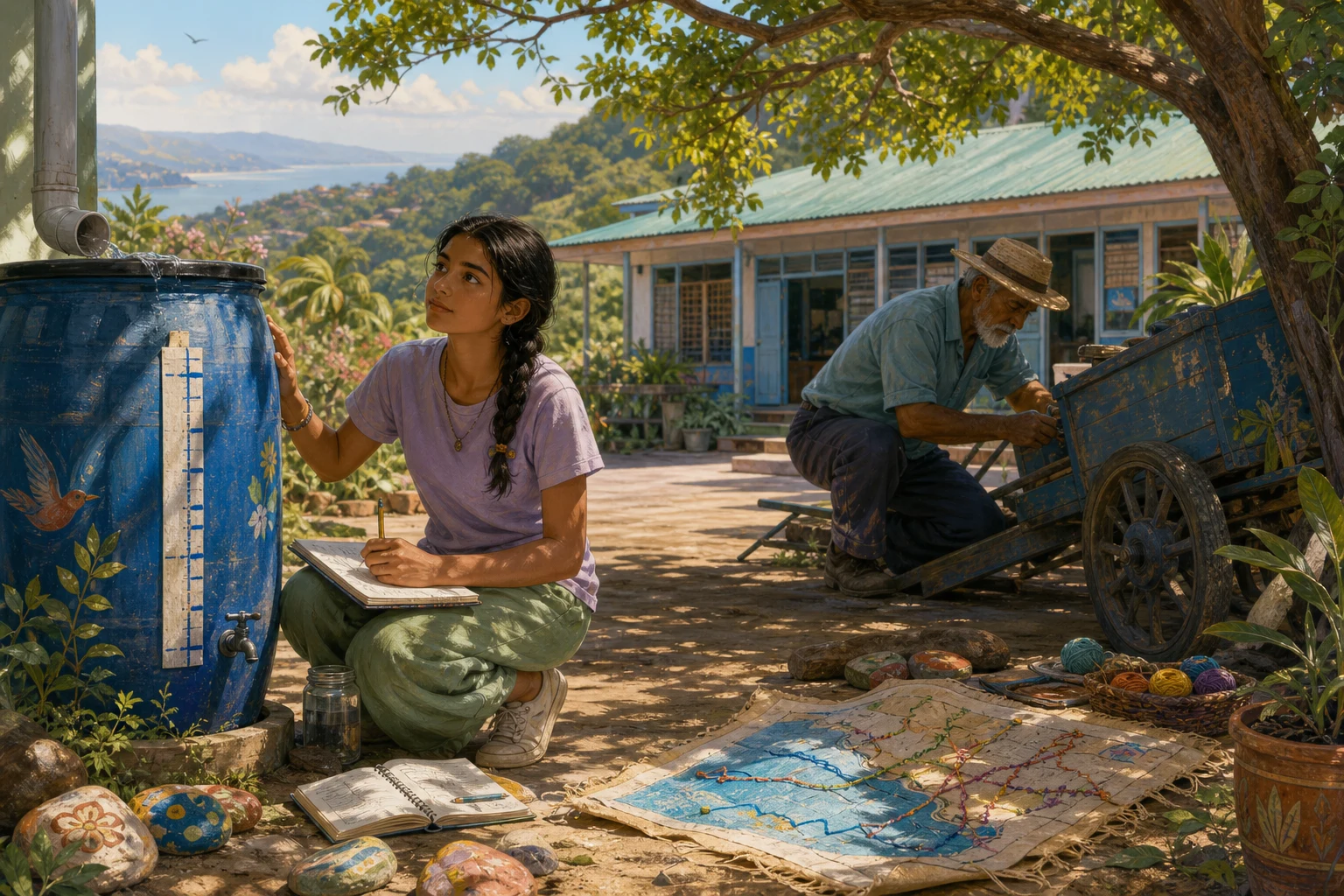
The rain barrel wore a blue ring around its middle, exactly where the water had stopped rising.
Luma crouched beside it with a ruler in one hand and a notebook in the other. The barrel stood behind the hillside school, beneath a tamarind tree whose leaves cast a shifting net of shade across the stones.
“Still nothing impressive,” she muttered.
Her grandfather, Sefu, was replacing a cracked handle on the grounds cart. “You measured the barrel.”
“I measured an empty barrel.”
“An empty barrel can tell you where the rain went.”
Luma shut the notebook. She had wanted to enter the interschool geography challenge, but every time she imagined the judges asking about her school, she pictured their disappointment. Other students could study cliffs, rivers, old bridges. Her school had a dusty courtyard, three vegetable beds, and a rain barrel that had forgotten how to fill.
Sefu tapped the ruler. “What do you have?”
“Thirty-two centimeters.”
“Yesterday?”
“Thirty-two.”
“Then tomorrow you will know whether the water is leaving through the tap, the soil, or the sun.”
He handed her six smooth stones painted in different colors. Together, they placed one beside the eastern garden, one beneath the neem tree, one near the kitchen, and three along the path descending toward the village. Each morning, Luma recorded the shade, the dampness of the soil, the number of buckets used, and the height of water in two handmade gauges cut from glass jars.
Soon, three classmates joined her. They discovered that the vegetable beds stayed damp longest beneath the neem tree. They noticed that the western path received fierce afternoon sun and that water carried there disappeared quickly into cracked ground. They marked each observation on a large sheet of paper with colored thread.
The sheet became a map—not of roads or borders, but of thirst.
Then the dry season tightened its grip. The communal water committee had money for two new barrels and three possible locations. The shopkeepers wanted them near the market. The farmers wanted them at the foot of the slope. Families living above the school argued that the barrels should be close to their homes.
At the meeting hall, voices rose like startled birds.
“The market serves everyone.”
“The lower fields lose half the water before it reaches them.”
“People at the top must walk too far.”
Luma sat beside Sefu, clutching the map. Her stomach felt full of stones. She had planned to speak, but the adults sounded certain, and certainty was louder than her courage.
Sefu leaned toward her. “You do not need to win.”
“What if they say I’m wrong?”
“Then ask which part. A map can be corrected. Guesswork is harder to repair.”
When the chairperson asked whether anyone had measured the proposed sites, Luma stood.
At first, her voice barely crossed the room. She held up the painted stones and explained what each color meant. She showed the water levels recorded over twelve mornings. The market site was convenient, but its barrel would lose water quickly to afternoon heat. The lower slope held water well but served fewer homes. The school’s neem tree offered shade, and a second site near the upper footpath would shorten the longest walk.
A shopkeeper interrupted. “Those are children’s observations.”
Luma looked at the map. “Yes. But the sun did not know our ages when it dried the western gauge.”
The room grew quiet.
Instead of choosing one side, the committee tested the proposal. They placed small measuring jars at all three sites for a week, then compared evaporation, use, and walking distance. The results matched most of Luma’s notes. The barrels went beneath the neem tree and beside the upper footpath, with a simple schedule for refilling them.
The geography challenge took place two weeks later. Luma did not bring a polished model or a dramatic speech. She brought the map, the painted stones, and the notebooks with muddy fingerprints along their edges.
She did not win first place. Her team received a special mark for practical observation, which Luma thought sounded better than a trophy because it described what they had actually done.
Back at school, Sefu helped her paint a new line inside the barrel: not a promise that it would always be full, but a reminder to check before carrying water elsewhere.
By the next rainy season, the map had grown. New students added roof angles, puddle paths, and the places where thirsty plants recovered first. Luma left the original stones beside the barrel, bright against the earth.
The village had not become easier to understand. It had simply become worth looking at closely.
Related Quote Stories

When Desks Learned to Bend
Nera’s first folding desk collapsed under the weight of a single book. Hiding the failure would be easy; inviting others to inspect it would be harder—and far more useful.
Read Story →
A Map Woven in Blue
Ilya’s patchwork bench covers began with lost gloves and ended as a map everyone could help complete.
Read Story →
The Hour Nobody Owned
Mina’s first community hour is lively, crowded, and almost entirely controlled by the loudest guests. A ferry cleaner, a brass token, and one patient adjustment teach her what true hospitality requires.
Read Story →