
Quote Stories
What the Broken Notes Were Saying
A repairer learns that listening is part of every craft.
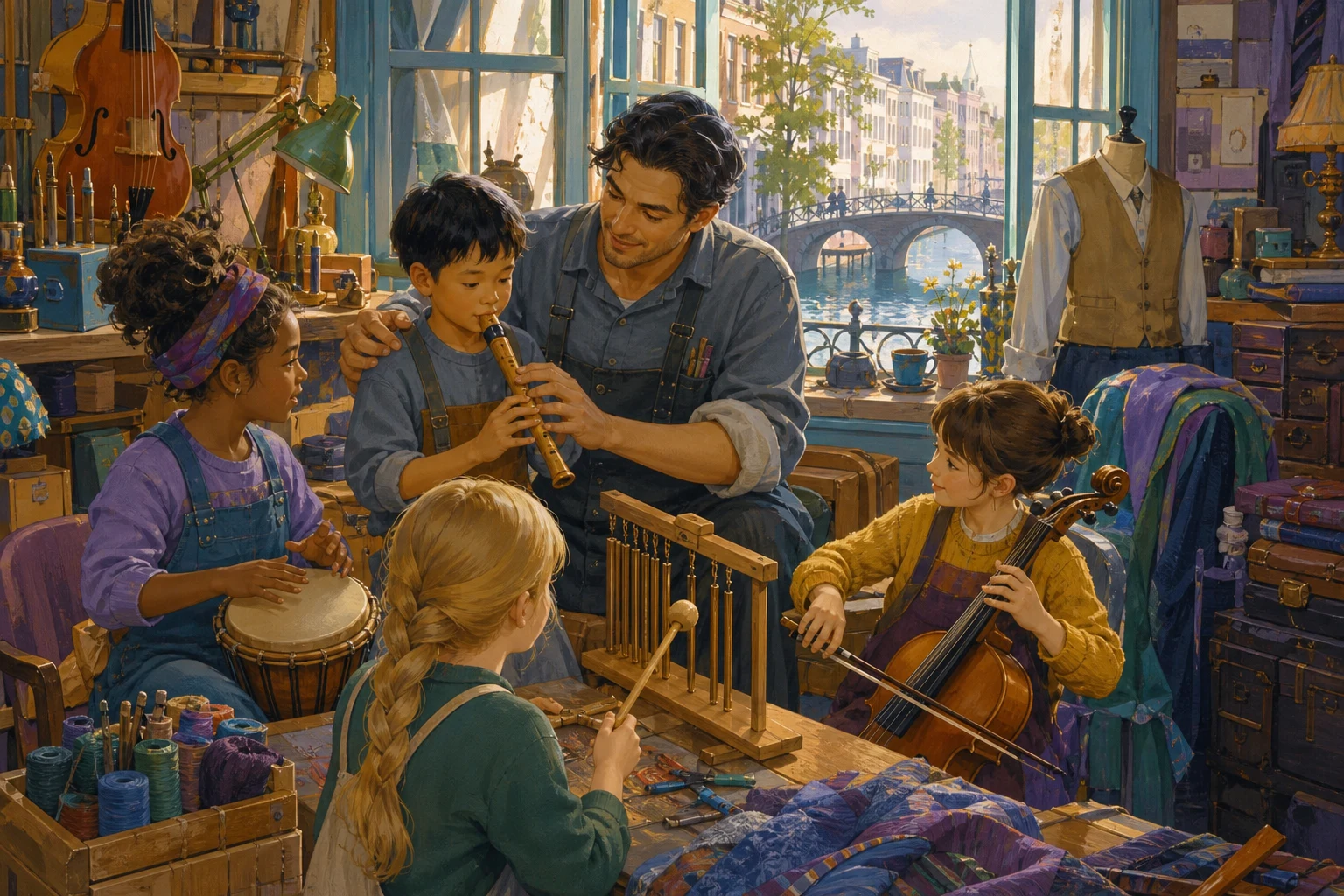
The recorder gave one sharp, offended squeak and fell silent.
Daro stared at the new mouthpiece. He had filed its edge smooth, sealed the join, and tested it against three different lights. The repair was sound.
“Try it again,” he said.
The girl raised the recorder. She blew a long, careful breath. Squeak.
“It doesn’t do that for me,” Daro said.
“It does it for me every time.”
He looked from the instrument to the girl, then toward the open window above the tailor’s shop. Below, scissors clicked through layers of blue cloth. Beyond the awning, canal water slipped beneath a covered bridge, carrying reflections of balconies and laundry lines.
Daro had rented the room because it was cheap, quiet, and large enough for a workbench. He repaired discarded instruments after his shifts maintaining the city’s old lift machines. His tools understood him. Springs failed for reasons. Gears did not become embarrassed when questioned.
Children, however, had begun arriving with bags of musical trouble.
A drum with a torn skin. A stringed toy missing its bridge. A tin whistle that played only one note, though its owner insisted it knew six. Daro repaired each item quickly and handed it back, expecting gratitude to sound something like silence.
Instead, the problems returned.
The drum split again because its owner struck the rim, not the center. The toy’s bridge snapped because the child played it while sitting on the floor. The whistle had never been broken at all; its six notes appeared only when held sideways.
Daro began keeping a notebook. On the first page he wrote: ASK BEFORE REPAIRING.
The next afternoon, he placed three stools beside his bench.
“Show me how you use it,” he told the children.
They looked suspiciously at one another.
“Before you fix it?” asked the boy with the drum.
“Especially before.”
The girl with the recorder demonstrated her song. She played with her thumbs tucked underneath, twisting slightly whenever she changed notes. Daro adjusted the mouthpiece by less than a finger’s width. The squeak vanished.
She played again. This time the sound rose clear and bright, startling the pigeons on the roof.
Daro wrote down the adjustment.
“Can I try?” asked the boy with the drum.
Daro handed him a strip of spare leather and showed him how to reinforce the rim. The boy tried, failed, and tried again. By closing time, the patch was crooked but firm.
The room changed after that. It no longer held only the smell of oil, wood dust, and hot metal. It filled with tapping, plucking, blowing, and occasional disasters. Daro learned that a stringed toy sounded best near the window, that one child counted rhythm by tapping her heel, and that another could hear a loose screw before anyone else noticed it.
He stopped repairing instruments alone.
On Saturdays, each visitor took a turn testing a solution. One child held the drum while another tightened its laces. Someone played a melody while Daro adjusted a valve. The tailor downstairs sent up scraps of felt, and the children used them to make cases. A lift operator brought a box of discarded brass buttons, which became rattles, fasteners, and one surprisingly effective set of chimes.
Then the city’s annual bridge festival approached. The music kiosk near the canal had been silent for months, its roof leaking and its small stage cluttered with broken stands. The festival committee asked Daro whether he could make the kiosk usable again.
He nearly said no. The job was larger than his room, his tools, and his confidence.
The children said yes for him.
They measured the stage. They sorted wood by length. They tested sounds beneath the roof to find where the rain drummed loudest. Daro repaired the stands, but the children painted their feet in different colors so musicians could quickly match each stand to its instrument.
On festival morning, clouds gathered over the bridges. A gust tore one painted sign loose and sent it skimming into the canal. The first performance was due in twenty minutes.
Daro reached for his hammer.
“Wait,” said the recorder player. “What does the sign need?”
Daro looked at her. Then he looked at the children, the scraps of felt, the spare wire, and the row of instruments they had learned to understand together.
“Another way to hold it,” he said.
They made one.
By sunset, the kiosk rang with music. Some notes were polished; others wobbled bravely. The repaired drum boomed beneath the bridge. The sideways whistle played all six notes. When the recorder began its clear melody, Daro heard no squeak at all.
After the final song, the children returned to the room above the tailor’s shop. They placed their instruments on the bench, not as broken things awaiting rescue, but as tools they now knew how to question.
Daro opened his notebook. Beneath ASK BEFORE REPAIRING, he added another line:
Leave room for the player.
Then he moved the workbench closer to the window, where there was space for one more stool.
Related Quote Stories
Forms with Room to Breathe
A legal clerk who once answered every question discovers that the best guidance leaves people ready to answer one another.
Read Story →
When the Airwaves Remembered
Lenora planned to read weather notices forever. Then a missing verse, a patient sound engineer, and a box of old kitchen spoons turned her quiet radio hour into a gathering place for many voices.
Read Story →
Light Through the Practice Glass
Belen trusted glass more than people. Glass showed every flaw immediately; people waited until later. Then a theater deadline forced her to choose between protecting her reputation and opening her work to others.
Read Story →