
Quote Stories
What the Objects Remember
Ivo learns that a repaired thing is never just a thing.
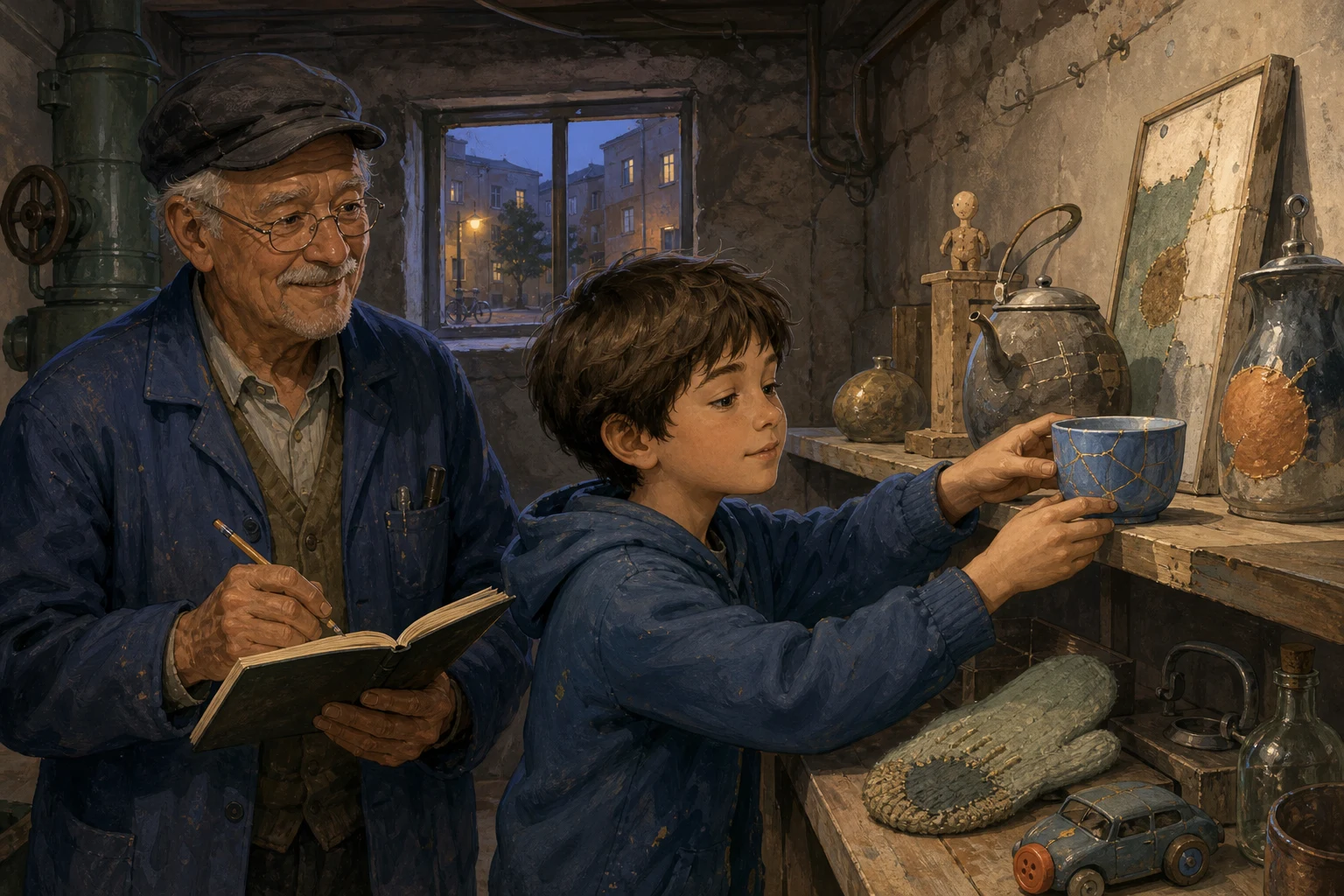
Ivo arranged the exhibits by size: cup, mitten, toy car, wooden spoon, clock, chair leg.
The display filled half the classroom table and looked, to Ivo’s great satisfaction, enormous.
“Where are the labels?” asked his teacher.
Ivo pointed to the objects. “Everyone can see what they are.”
His teacher lifted the cup. A pale blue crack ran around its middle, held together by a careful line of glue.
“They can see the cup,” she said. “Can they see why it matters?”
Ivo looked at his collection. He had gathered each thing from the apartment blocks around his courtyard: the mitten from the woman who sold apples, the toy car from the twins upstairs, the spoon from his mother’s kitchen. He had chosen them because they were damaged and still useful. He had not thought the objects needed anything else.
That evening, he carried the cup to Mr. Varek, the retired lift mechanic who lived beneath the stairs and kept screws in matchboxes.
“Your museum has parts,” Mr. Varek said after listening. “But no movement.”
“It is not a lift.”
“Everything moves if you know where to look.”
Mr. Varek turned the cup in his broad hands. He told Ivo how his wife had bought it at a market before they could afford a matching set. Years later, during a winter power cut, she had dropped it while carrying tea to a neighbor. She had glued it herself, badly at first. Mr. Varek had improved the repair, but she had insisted that the first uneven line remain.
“She wanted the cup to show both attempts,” he said. “Hers and mine.”
Ivo returned to school with a notebook.
He wrote: Blue cup. Dropped during a power cut. Repaired twice. First repair kept.
Then he interviewed the mitten’s owner. The mitten had been patched with thread from an old scarf because its owner’s daughter had worn it on her first day of school. The wooden spoon had lost its handle and gained one carved by a grandfather who had measured it against the cook’s palm. The toy car had been repaired with a button for a wheel.
When Ivo read the notes aloud, his classmates began looking at the collection differently.
“I have a lunch tin with three names scratched underneath,” said Mira.
“My uncle fixed our radio with wire,” said Petar.
“My grandmother keeps a bowl with a silver staple,” said Anja. “Can I bring it tomorrow?”
Soon the museum spread beyond Ivo’s table. Children arrived with objects and questions. They learned not to ask, “Who made this?” first, but “Who cared enough to fix it?”
Then a notice appeared in the entrance hall: renovation would begin in six weeks. Residents argued over what had to go. Old cupboards blocked the basement. Broken lamps filled the storage room. Someone suggested clearing every shelf.
At the next building meeting, voices bounced beneath the stairwell.
“Keep nothing,” said one resident. “We need space.”
“Keep everything,” said another. “You never know what people will regret losing.”
Ivo carried his notebook to the front. His knees trembled, but he opened to a fresh page.
“Maybe we can decide item by item,” he said. “Not whether it is old. Whether someone can tell us why it should stay.”
Mr. Varek nodded toward the residents. “A building is also a machine. You listen for what is carrying the weight.”
So they made three tables: keep, repair, and release. The keep table held a painted sign from the first courtyard shop. The repair table received a bench with a loose slat and a cupboard whose hinges still worked. The release table filled with objects no one remembered and no one needed.
But before anything left, residents had one week to tell its story.
By the end, the basement had space again. The repaired bench stood near the entrance. The sign hung above it. Ivo’s museum occupied one narrow wall, each object beside a small card bearing its history.
His teacher visited and studied the blue cup.
“Now,” she said, “I can see it.”
Ivo smiled. He had once believed preserving meant rescuing every object from being thrown away. Now he understood that attention could do something more careful. It could separate a burden from a memory, a useful repair from a useless pile, and a thing from the hands that had kept it going.
Mr. Varek placed a matchbox on the museum shelf. Inside were three screws, a brass button, and a tiny spring.
“What do they belong to?” Ivo asked.
“Not yet,” said Mr. Varek. “That is why they stay.”
Related Quote Stories

Wind Has Opinions
Eren wanted the festival record. Then the wind tore his masterpiece apart and gave him a better challenge: design something that could belong to everyone.
Read Story →
What the Hillside Knew
When her first planting failed, soil surveyor Amara traded certainty for questions—and found the hillside already had teachers.
Read Story →
Light Finds a Way
Beni wanted applause. What he found beneath the hall’s floorboards was something better: a way for many hands to make the evening shine.
Read Story →