
Quote Stories
When Every Mark Meant Something
Imani learns that a useful system must leave room for everyone’s hand.
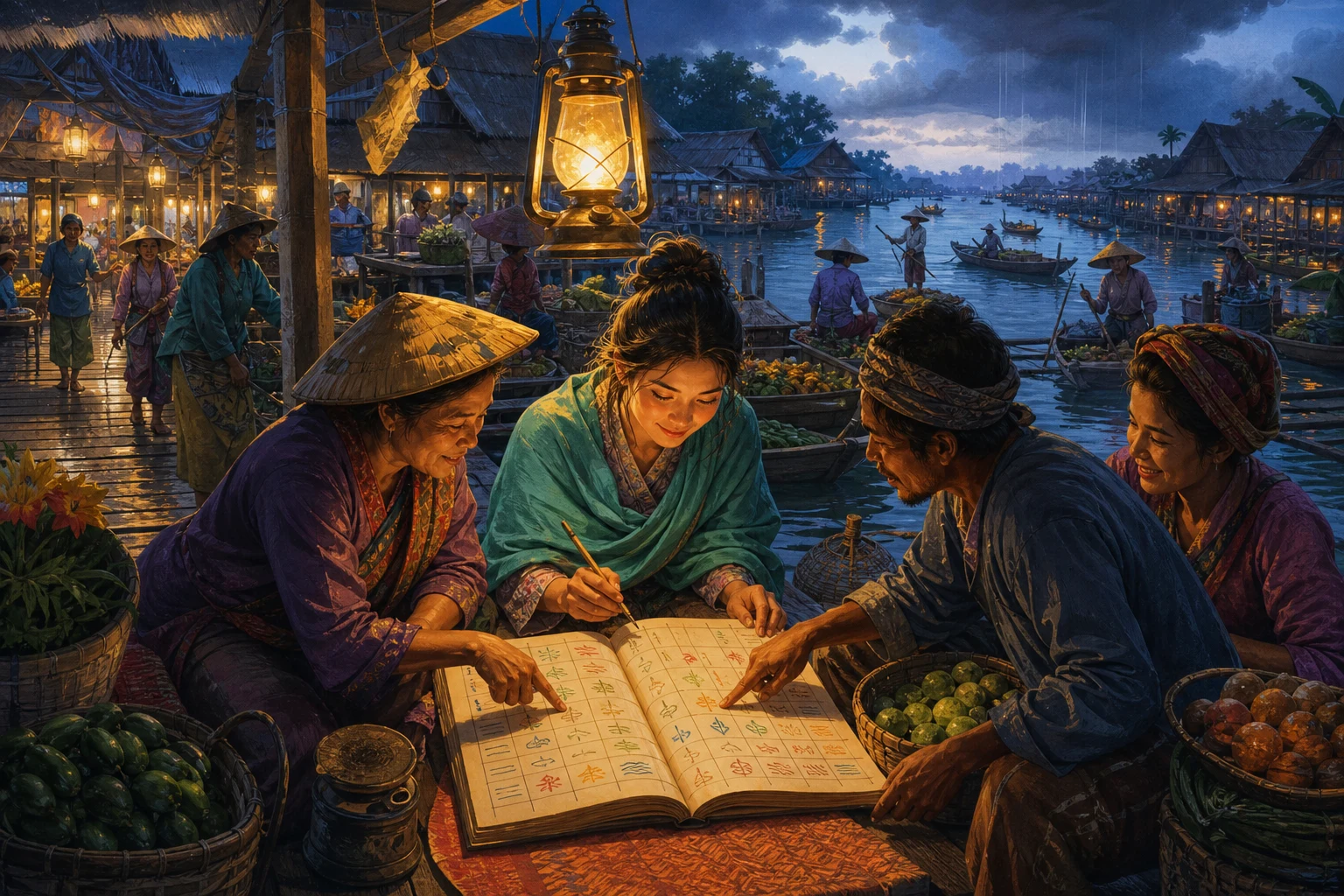
Imani’s first ledger could tell you who borrowed three coils of rope on the second Tuesday of the wet season. It could not tell you where the rope was now.
She had spent six evenings ruling columns beneath the yellow glow of a market lantern. There were pages for crates, pages for boat departures, pages for shared baskets, and a narrow appendix for things that had been promised but not yet delivered. Her handwriting marched across every line.
The ledger sat open on a plank between two floating stalls. Nobody touched it.
“Which page is the ginger?” called Uncle Sefu from his boat.
“Page fourteen,” Imani answered.
“Which fourteen?”
“There is only one page fourteen.”
“There are three pages with numbers near fourteen.”
Imani looked down. He was right. She had numbered the sections separately.
By the end of the week, a school-aged helper named Bako had used the ledger to prop open a basket lid. A spice seller had tucked a receipt inside it. Two boaters had placed cups on its most carefully drawn map.
Imani wanted to defend the work. Instead, she began asking questions.
She asked which marks people remembered quickly, which deliveries were hardest to trace, and what they did when they forgot to write something down. A pepper seller drew a circle for a full basket and a half-circle for a basket already opened. A boater suggested three short lines for a crossing. Bako proposed a tiny lantern for anything needed before dark.
“Why a lantern?” Imani asked.
“Because everyone looks at one,” he said.
So Imani started again.
The new ledger had no long explanations. A blue wave meant a boat. A green leaf meant produce. A red dot meant “needed soon.” A small lantern meant “before the evening market.” Beside each exchange, there was space for a name—or, if someone was rushing, a quick initial and a direction: left stall, third boat, school bridge.
She also introduced ledger hour. Each evening, one person sat beside the lantern for twenty minutes. Anyone could record a borrowed scale, a shared delivery, a missing basket, or a favor that needed returning. The duty moved from stall to stall.
At first, people made mistakes. Imani corrected them automatically, then learned to ask, “Will you remember that mark tomorrow?” If the answer was no, they changed it.
Three nights before the river festival, a delivery arrived in darkness. The boat carried rice, clay cups, cooking oil, and bundles of reed mats. In the confusion, two crates were unloaded at the wrong bridge. The oil went toward the musicians. The cups went toward the lantern makers. The rice was nowhere anyone expected.
Rain began tapping the water.
“We’ll lose half of it by morning,” said Mara, who ran the festival kitchen.
Imani opened the ledger. Her first instinct was to take control, turn back through every entry, and rebuild the route herself.
Then she saw the lantern symbol beside the delivery note.
“Everyone who handled a crate, come here,” she said. “Not to explain. Just to mark what you remember.”
Mara drew a red dot beside the oil. Bako added three crossing lines. A boater marked the bridge where he had seen the rice. The lantern makers remembered receiving a crate with a torn reed strap. A child who had been carrying cups pointed to a symbol she recognized from the afternoon ledger hour.
The marks formed a crooked trail across the page.
They found the rice beneath a tarpaulin near the old ferry steps. The cups were carried back by three laughing vendors. The oil reached the kitchen before the rain strengthened, and the reed mats were stacked beneath the musicians’ awning.
The next evening, Imani found the old ledger in the bottom of her storage box. Its pages were beautiful. Its information was exact. She kept it—not as a record to be followed, but as a reminder of what happened when careful work forgot to make room for other hands.
At ledger hour, she placed the new book beneath the lantern and left the pen uncapped.
Bako drew the first mark. It was a crooked little lantern with rays in every direction.
“What does that mean?” Imani asked.
He grinned. “Useful before dark.”
Related Quote Stories

A Map Woven in Blue
Ilya’s patchwork bench covers began with lost gloves and ended as a map everyone could help complete.
Read Story →
Tabs in the Wind
Kito’s first calendar was neat, accurate, and almost useless. The second one belonged to everyone.
Read Story →
Where the Shade Falls
Tomas had already measured the orchard for sale when three young workers asked whether they could borrow it for one afternoon.
Read Story →