
Quote Stories
When the Court Changed Shape
Kian learns that a fair game needs more than identical rules.
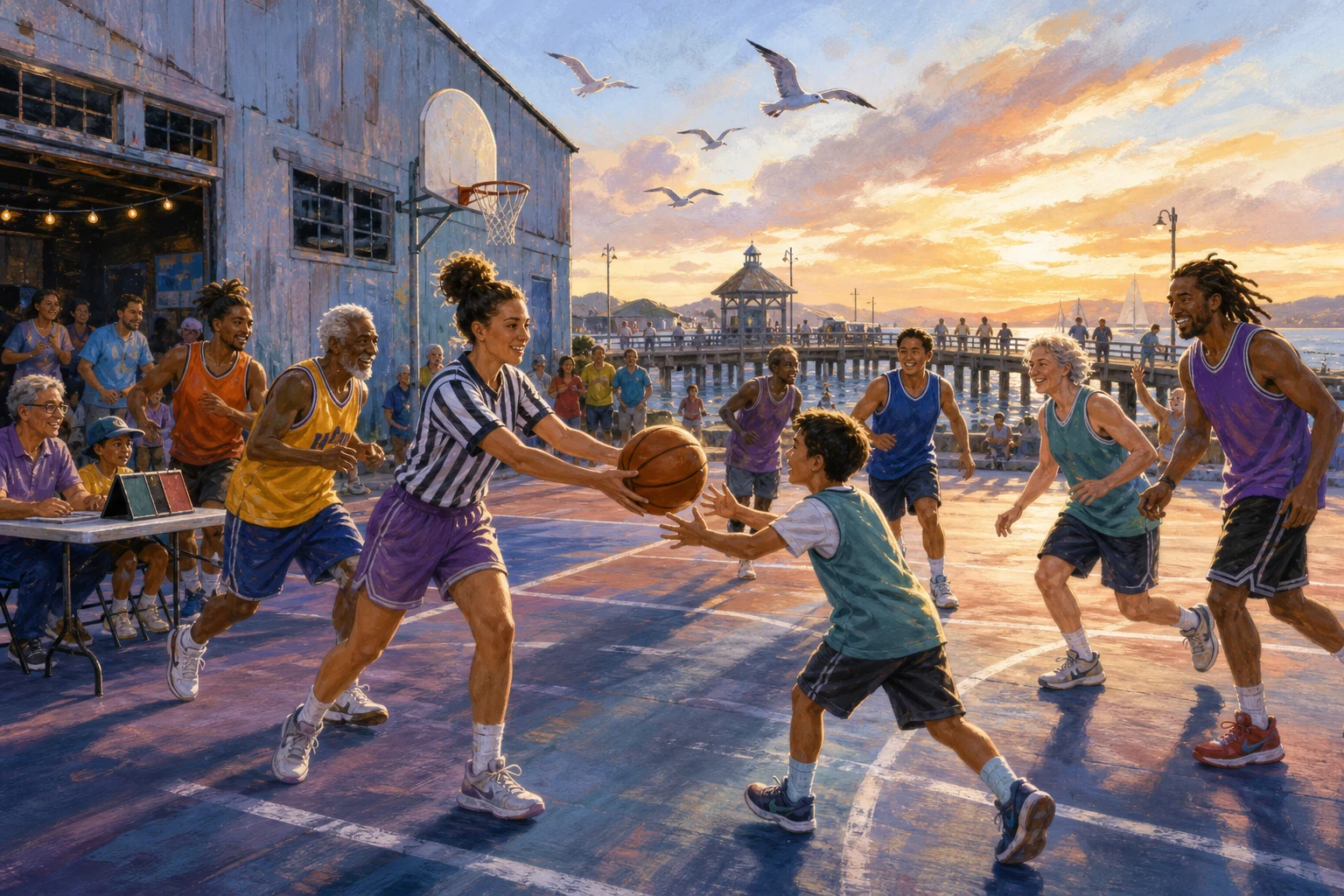
“That substitution is illegal.”
Kian’s whistle cut across the recreation pier, sharper than the gulls and the wind coming off the water. He held up one hand, the other gripping a clipboard crowded with brackets, arrows, and emergency rule changes.
“Which rule?” called someone from the sideline.
Kian pointed to the page. “Section four. Players rotate only during stoppages.”
“But Mina’s eight,” said a captain in a yellow jersey. “She can’t guard their tallest player for six minutes.”
“She can sit until the next stoppage.”
Mina’s face tightened. Behind her, two older players were already arguing about whether a substitute had signed the roster. At the next court, a group of university students disputed the score. Near the fence, three children who had come hoping to play had been handed a ball and told to wait.
Kian blew the whistle again. The game resumed, though nobody looked pleased.
He had agreed to organize the tournament because the previous coordinator had moved away. Kian knew basketball rules by heart. He had refereed weekend games, memorized tie-break procedures, and printed enough brackets to cover the folding table twice over. A tournament, he believed, became fair when every team received the same instructions and every decision could be traced to a line on paper.
By noon, the paper had begun to curl in the sea air.
One team wanted mixed-age substitutions. Another had brought only four players. A player with a sore ankle asked to keep score instead of defend, but Kian could not find a rule that explained how to count that contribution. When rain swept across the pier, everyone crowded beneath the awning, talking over one another.
“This isn’t a tournament,” said a woman wearing a green headband. “It’s a queue for being told no.”
Kian looked down at his clipboard. The ink had run through the word FAIR.
He could have canceled. Instead, he carried the folding table into the old warehouse beside the court and asked the captains to sit down.
“Tell me what the tournament is supposed to make possible,” he said.
The first answer was simple: playing time. The second was belonging. Someone wanted younger players to learn without being embarrassed. Someone else wanted a competitive final. A quiet captain named Sol wanted people to be able to change roles when their bodies tired. Mina suggested that every team should have a player, a scorekeeper, and a timekeeper—and that those jobs should rotate.
Kian wrote everything on the back of the brackets.
“What about the rules?” he asked.
“Keep the rules that protect the game,” said Sol. “Change the ones that only protect the schedule.”
They rebuilt the afternoon together. Games became shorter. Teams could request one planned rotation in each quarter. Any player could trade court time for scorekeeping, coaching, or organizing equipment. The scorekeeper from each team checked the other team’s numbers, so no one person carried the burden of being correct. Between rounds, players could choose the next matchup from the teams ready to play.
The final would not be determined by the original bracket. It would be chosen by the players after they had seen who wanted another challenge and who needed another chance.
Kian expected the new system to collapse.
Instead, it breathed.
Mina played the opening minutes, then moved to the sideline and kept time while her older teammate showed her how to record fouls. A university player taught a younger child a bounce pass. Two rivals discovered they both preferred defending to shooting and began laughing whenever they blocked one another. The games remained spirited—there were still groans, missed calls, and dramatic appeals—but arguments ended faster because more people understood what was happening.
At sunset, the teams gathered around the final score sheet. Nobody had the same opinion about which game deserved the final slot. So they voted for two: one close, fast-paced match between the strongest teams, followed by a mixed game with players chosen from every roster.
Kian refereed the first. For the second, he handed the whistle to Sol.
“You’re not going to call it?” Sol asked.
“I’m going to play.”
He stepped onto the court with a borrowed blue jersey and no clipboard. The wind lifted the corner of the score sheet, but three hands reached for it before it could fly.
The mixed game had no neat ending. The last basket bounced off the rim, and the final score was tied. Rather than add extra time, the players decided to finish with a passing challenge: every person on the court had to touch the ball before anyone could shoot. The ball moved from tired hands to eager ones, across ages and teams, until Mina caught it beneath the basket.
She passed instead of shooting.
The next player passed too. Then Kian received the ball, looked toward the rim, and sent it across the lane to a child who had spent the morning waiting beside the fence.
The child made the basket.
For a moment, the only sound was the harbor wind pushing against the warehouse doors. Then everyone cheered—not for the score alone, but for the long chain of decisions that had made the shot possible.
Later, Kian folded the original brackets into a box. He kept one sheet for the record, though the ink had blurred until the lines looked less like commands and more like suggestions.
On Monday, he would print a new version. It would have rules, certainly. A game needed boundaries. But beside each rule, he would leave a blank space for the people playing it.
The court had not become less fair when it changed shape. It had become large enough for more people to stand on it.
Related Quote Stories

The Hour Nobody Owned
Mina’s first community hour is lively, crowded, and almost entirely controlled by the loudest guests. A ferry cleaner, a brass token, and one patient adjustment teach her what true hospitality requires.
Read Story →
A Tune for Every Pocket
Celia could repair almost anything with a spring, a screwdriver, and enough patience. Her niece’s silence in music class required something different.
Read Story →
Chimes Along the Canal
Noor’s bicycle-bell sound trail begins as a clever school project and becomes something better when she listens to the neighbors it interrupts.
Read Story →