
Quote Stories
When the Quay Learned to Wait
Pema’s chalk marks turn a missed delivery into shared knowledge.
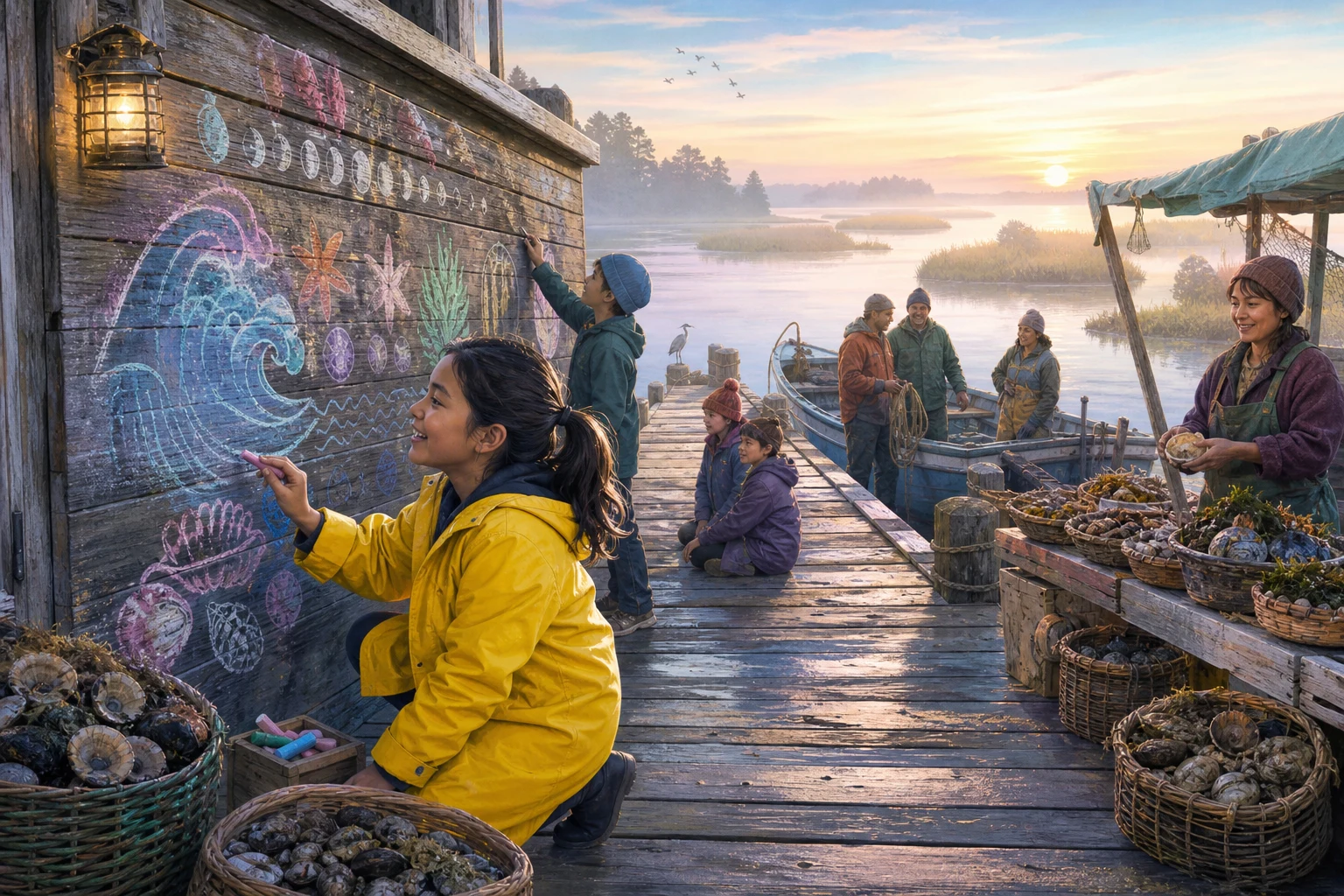
Pema could name the tide before she could see it.
“High water at six-fifteen,” she announced, balancing on the edge of her brother’s shellfish stall. “Low water at twelve forty-two. Rising again after sunset.”
Her brother Tashi grinned while he arranged baskets of river prawns beneath a striped awning. “Then you can tell the visitors why their boats are late.”
“They aren’t late,” Pema said. “The visitors are early.”
That happened often on the quay. Travelers arrived carrying empty baskets and hopeful expressions, only to discover that the market boats had already crossed toward the reed islands. Local fishers spoke of the water as “first silver,” “after the mud shows,” or “when the herons leave the posts.” Pema preferred numbers. Numbers behaved.
So, one bright morning, she borrowed a bucket of white chalk and covered the quay wall with a tide table. She drew a rising blue arrow, a falling blue arrow, and large careful figures beneath each one. Beside the figures, she added the expressions she had heard from the boat crews.
By breakfast, people were admiring it.
By midmorning, three delivery carts were waiting at the wrong landing.
A boat crew had said “after first silver,” meaning the tide just after dawn. Pema had matched it with the next official time on her school chart. Visitors waited. The boats left. Tashi returned with empty baskets and a face that was trying not to look disappointed.
Pema stared at the chalk marks. The arrows seemed to lean away from her.
“I made it clear,” she said.
“You made it tidy,” Tashi replied gently. “That isn’t always the same thing.”
The words stung more than an angry scolding would have. Pema took the chalk from the wall, but before she could scrub anything away, an old boat builder named Sella tapped the table with her walking stick.
“Don’t erase it,” Sella said. “It is wrong in an interesting direction.”
Pema frowned. “Wrong is not interesting.”
“It can be, if it teaches you where you stopped listening.”
That afternoon, Pema carried a notebook along the quay. She asked each boat crew when they used the tide expressions. She asked grandparents which landmarks they watched. She asked younger children how they knew when it was safe to cross the slippery boards between the floating platforms.
The answers refused to line up neatly.
“First silver is when the water catches the sun,” said one fisher.
“No,” said another. “It is when the sun catches the water near the north reeds.”
A schoolboy named Nilo showed Pema a place where visitors could wait under a roof without blocking the carts. Two sisters suggested drawing a basket beside the times when shared errands crossed the channel. Sella brought an old brass tide gauge and showed Pema how its marks changed according to the shape of the moon.
Pema stopped trying to find one perfect translation. Instead, she began comparing them.
Three days later, the wall looked completely different. It held pictures rather than sentences: a silver line for first light, a heron for the birds leaving the posts, a basket for the morning delivery boat, and a green shelter for safe waiting. Alongside each picture were two times—one from the official chart and one checked against the crews’ experience.
At the bottom, Pema drew a small circle with an opening in it.
“What is that?” Tashi asked.
“A place for corrections,” she said. “The board needs room to change.”
The next morning, a visitor arrived just as fog rolled over the water. He pointed at the board, then at the floating platforms.
“Which way?” he asked.
Pema started to answer. Then she noticed Nilo nearby, carrying a basket for an older neighbor.
“Let’s check,” she said.
Together they compared the tide gauge, the fog, and the boat crews’ signals. The visitor reached the shelter before the boards grew slick. When the market boat arrived, he was ready with his empty basket and a grateful smile.
Pema’s chalk table never became perfect. Rain softened it. Children added new symbols. Boat crews corrected times. Someone drew a comical crab beside the phrase “ask twice.”
But the quay grew easier to read.
One evening, as Tashi counted the day’s coins, he nodded toward the wall. “You still know the tides by heart?”
Pema looked at the crowded board, at the marks left by many hands.
“I know some of them,” she said. “The rest are safer when we check together.”
Related Quote Stories
Where the Arrows Pointed
Sava’s ferry guide was elegant, accurate, and nearly useless to anyone who had not already learned the islands. She set out to discover why.
Read Story →
Room for Another Plate
Vesa had always believed hospitality began with noticing an empty chair. It took a cold supper and an honest conversation to show her that welcome sometimes requires changing the whole table.
Read Story →
What the Key Could Not Open
Eren could make a bent key unlock a vanished palace, but his grandmother asked a harder question: who had actually held it?
Read Story →