
Quote Stories
Where Guests Could Breathe
Mariel’s second career begins with a storm, a mechanic, and a better question.
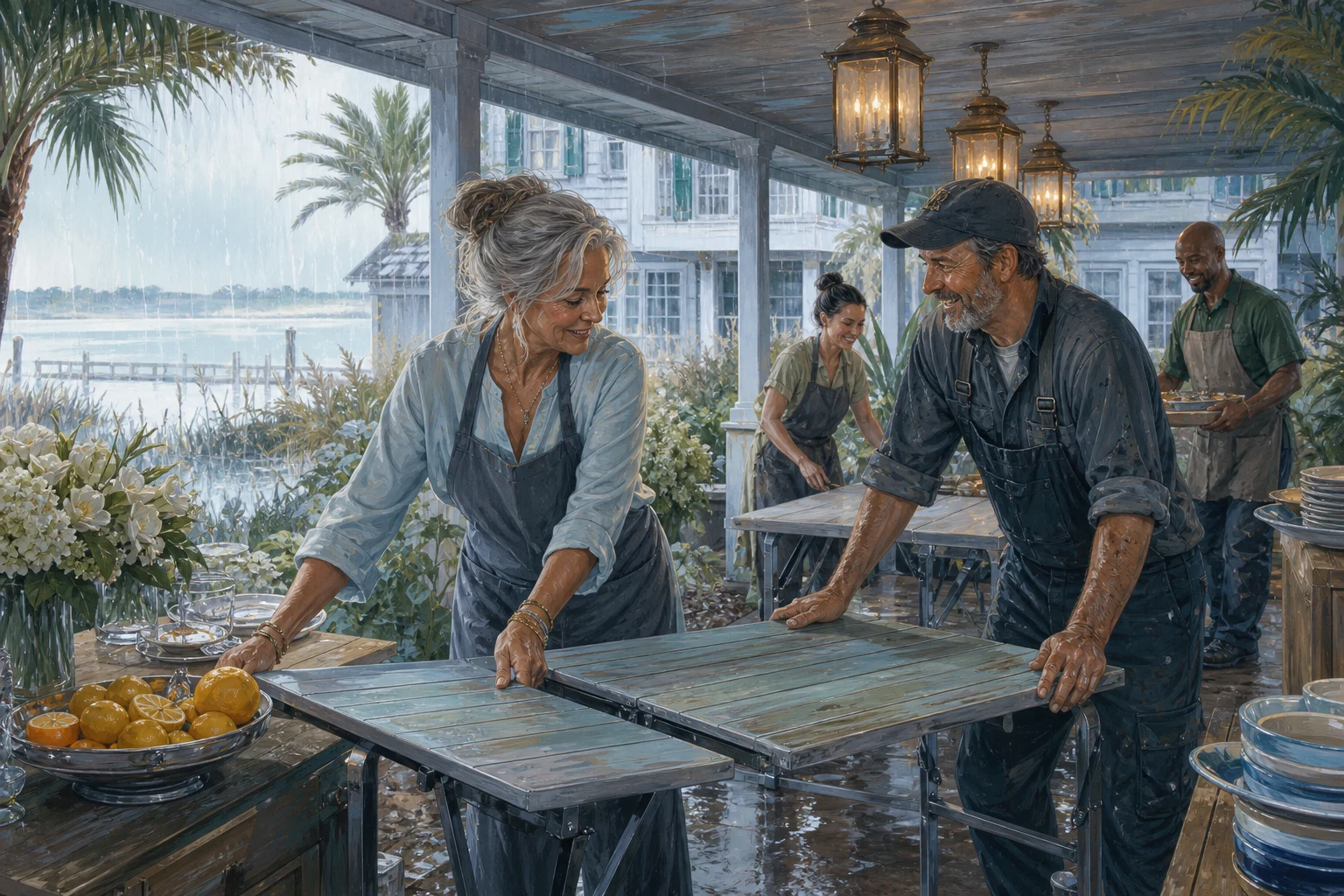
Rain arrived sideways, silver and furious, just as Mariel set the last glass on the table.
The courtyard had looked perfect an hour earlier: linen napkins folded like sails, bowls of citrus glowing beneath strings of bulbs, and a long rented canopy stretched over the supper. Now the canopy sagged. Water poured through its seams. One folding table buckled, sending peaches rolling into a flower bed.
Mariel caught a platter of roasted fish against her hip.
“Please tell me that was part of the menu,” called the host from the doorway.
Mariel looked at the peaches disappearing into the mud. “Only the rustic course.”
The joke earned a thin laugh. By morning, the booking was canceled. The rental company charged her for the ruined equipment, and two future clients asked whether she could guarantee better weather.
Mariel had catered for twenty-six years. She knew how to make a meal appear effortless, which meant she knew exactly how much effort had just vanished. For three days, she did not answer her phone.
On the fourth, she carried the broken table to the bus depot, where her old friend Tomas worked among engines and the smell of hot rubber.
“You want me to fix furniture?” he asked.
“I want you to tell me why it failed.”
Tomas crouched beside the warped legs. “Because it was designed to be folded, not carried. Different job.”
That sentence followed Mariel home.
They began with reclaimed panels from a closed dance hall. Tomas built a table that unfolded in sections. Mariel tested it in her covered courtyard with a pot of soup, six plates, and her own stubborn standards.
It was beautiful. It was also heavy enough to discourage anyone from moving it.
Mrs. Vale, who lived above the bakery, tried to lift one end and immediately set it down. “Lovely,” she said. “For someone with a young back.”
The second design was narrower. It fit beautifully through Mariel’s gate, but its center leg blocked the person sitting at the corner. A family hosting a birthday supper demonstrated this by bumping knees until the youngest child announced that the table was fighting them.
Mariel began keeping a notebook. At the top of each page she wrote the same three questions: Who carries it? Where does it go? What gets in the way?
She brought sample panels to courtyards, ferry-side kitchens, and shaded porches. Instead of explaining her designs, she watched people use them. Older hosts preferred lighter sections with handles. Families in narrow homes needed tables that could become a counter, a buffet, or two small dining surfaces. Cooks wanted covered stations that kept steam and rain away from matches, towels, and serving spoons.
Tomas listened without defending his welds. Mariel listened without defending her taste.
Their best design came from an unlikely request. A retired music teacher wanted to host twelve guests but had only a passageway barely wider than a broom. Mariel proposed a hinged table that opened against the wall and extended in three short leaves. Tomas added locking wheels and a removable middle panel.
When the teacher set it up, the table seemed to grow from the house itself.
“Now,” Mariel said, “where will you put the food?”
The teacher pointed to a slim covered station beside the stove. “Where I can reach it without abandoning my guests.”
That became the name of Mariel and Tomas’s small rental service: Reach.
Their first weekend brought four bookings, none glamorous. A family reunion under a carport. A retirement supper in a narrow lane. A neighborhood cooking class. A rainy anniversary breakfast held beneath a porch roof.
At the last one, clouds gathered before dawn. Mariel felt the old panic rise, sharp as vinegar. Then she watched Tomas secure the canopy, Mrs. Vale wheel two light table sections into place, and the retired music teacher arrange serving trays on the covered station.
The rain came hard. It drummed on the roof and blurred the street beyond the porch. Inside, nobody hurried. Plates passed easily. A child used the lowered end of the table for drawing. Someone moved a section aside so a guest with a cane could sit comfortably. Mariel’s fish stayed warm.
She stood at the edge of the gathering, not directing, not rescuing, simply watching the room make space for itself.
Tomas handed her a clean towel. “Good weather,” he said.
Mariel looked at the rainwater streaming from the eaves. “Excellent design.”
By the end of the season, Reach had become more than a rental service. It was a collection of useful answers: a table that turned a hallway into a dining room, a tray that locked onto a wheelchair-height surface, a cooking station that let hosts stay with their guests.
Mariel still folded napkins like sails. She still noticed crooked flowers and under-seasoned broth. But when new clients asked what she could guarantee, she no longer promised perfect conditions.
“I can help you make room,” she said.
And when the clouds gathered, she knew exactly where to begin.
Related Quote Stories

When Desks Learned to Bend
Nera’s first folding desk collapsed under the weight of a single book. Hiding the failure would be easy; inviting others to inspect it would be harder—and far more useful.
Read Story →
A Map Woven in Blue
Ilya’s patchwork bench covers began with lost gloves and ended as a map everyone could help complete.
Read Story →
Tabs in the Wind
Kito’s first calendar was neat, accurate, and almost useless. The second one belonged to everyone.
Read Story →