
Quote Stories
Where the Water Turns
Dara learns that a boat can be built from more than wood
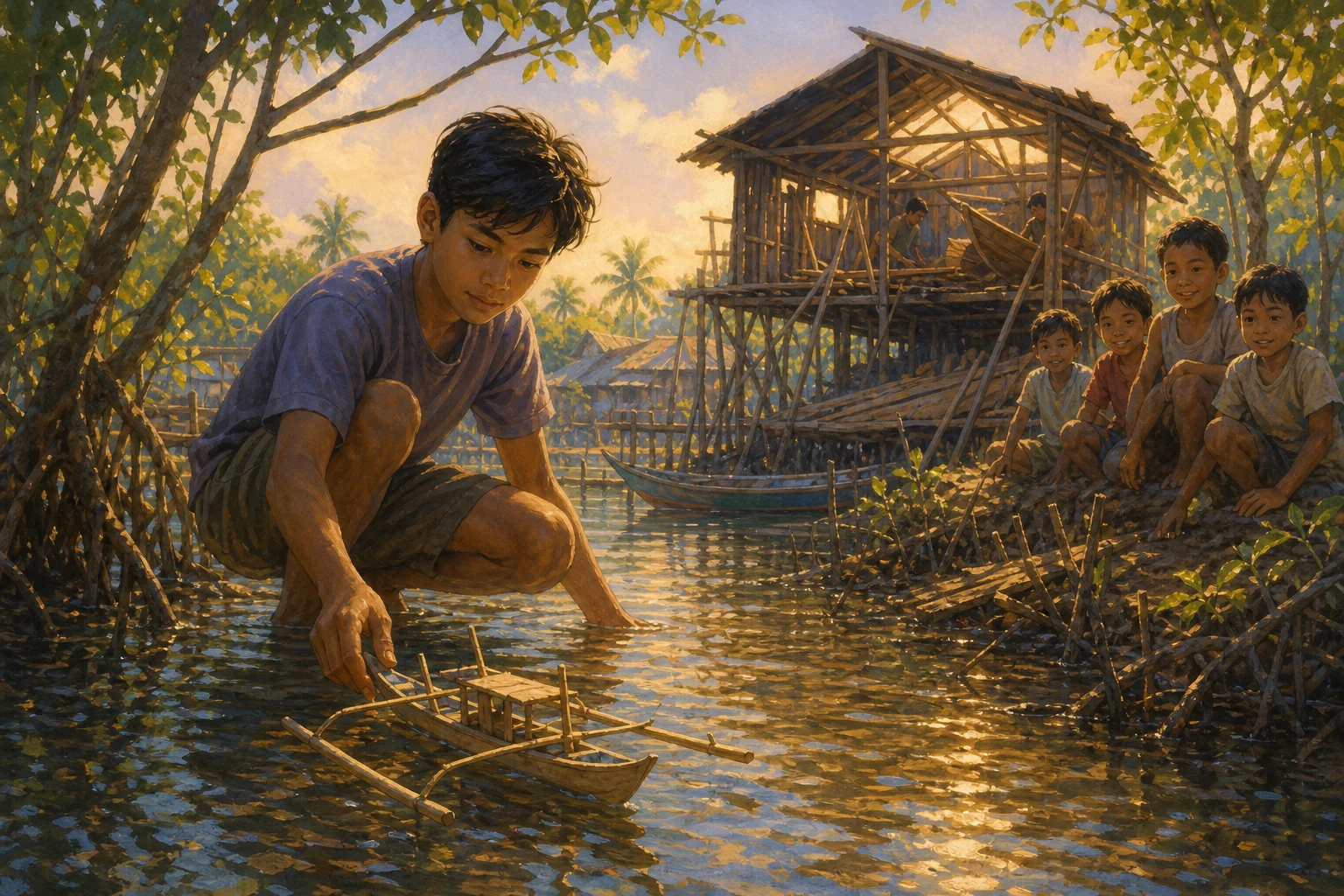
Dara’s boat flipped before it reached the second marker.
It turned neatly, almost politely, and came to rest upside down in the mangrove channel. One wooden outrigger floated beside it like a loose tooth.
From the bank, Dara’s uncle Bima raised both hands. “That is one way to stop.”
Dara waded into the warm water and dragged the model back by its rope. The boat was small enough to carry under one arm, built from thin scrap planks and bamboo ribs. She had shaped the hull after studying the fastest fishing outriggers at the morning wharf. Their pointed bows were elegant. Their narrow bodies cut through the water like knives.
They also stayed upright.
Dara’s did not.
The boat-building contest was six days away, and she had entered without telling Bima. The speed prize came with a brass compass, a bundle of good timber, and—more important—a place in the youth workshop held after the festival. Dara wanted all three. She wanted people to look at her design and understand that she could build more than repair cracked seats and replace worn lashings.
That evening, she turned the model over on the workbench. Water dripped from the joints onto the sawdust.
“Make it wider,” Bima suggested.
“Wide boats are slow.”
“Then make it less proud.”
Dara frowned. “Boats don’t have pride.”
“Builders do.”
She spent the next two days changing the shape. She added a second bamboo brace, shaved the hull thinner, moved the outrigger higher, and copied the angle of a racing boat owned by a fisherman named Jalo. Each version performed beautifully for a few breaths before tipping into the channel.
The children who played along the bank began to wait for the crashes. They cheered whenever Dara’s boat rolled.
“Again!” shouted little Suri.
Dara pretended not to hear her.
On the fourth morning, she carried the latest model to the wharf before sunrise. The tide had pulled away from the mud flats, leaving silver paths between the roots. Fishers pushed off in silence. Shell collectors walked ankle-deep along the shallows, carrying woven baskets. Farther out, a line of dark water moved against the current.
Dara watched her model tilt and sink.
Jalo, mending a net nearby, did not laugh. “You keep asking the boat to be quick,” he said. “Have you asked the water what it is doing?”
Dara almost answered sharply. Instead, she looked toward the mangroves.
The shell collectors showed her where the returning tide curled around submerged roots. A woman who gathered clams pointed to ripples that appeared before the current changed direction. Suri and the other children demonstrated how their leaf boats spun whenever they launched them from the bank. They had learned which puddles connected to the channel and which only looked deep.
Dara began carrying a stub of charcoal and a scrap of sailcloth. She marked the places where the water tugged sideways, where floating leaves gathered, and where the surface seemed calm but pulled hard beneath.
At first, her notes made no sense. Arrows crossed one another. Numbers smudged in the rain. She tried to explain the patterns to Bima and ended up drawing a fish with three tails.
“Excellent fish,” he said. “Unclear tide.”
She laughed despite herself.
Then she noticed something: the current did not strike the boat from one direction. It lifted the bow, pressed against the outrigger, and shifted again when the channel narrowed. Her narrow hull was fast only when the water behaved exactly as she expected.
Dara rebuilt the model.
She widened the lower hull, not the top. She moved the outrigger closer to the water and attached it with simple lashings that could be loosened and replaced. Along the sides, she added small wooden fins made from discarded crate slats. They were not graceful. They looked like the fins of a sleepy river fish.
The first test traveled slowly.
It also stayed upright.
Dara adjusted one fin. Then another. Suri suggested a shorter brace. A shell collector recommended raising the front lashings before the tide turned. Jalo showed Dara how to leave enough flexibility for the wood to move without splitting.
By the afternoon before the contest, the model had crossed the channel twelve times. It was not the fastest boat on the water. It was steady through the bends, easy to repair, and made from pieces nearly every workshop already had.
At the festival, the speed boats flashed between the markers. Dara’s stomach tightened as each one passed her model. When her turn came, the crowd leaned closer.
The boat moved out.
It crossed the first marker, dipped through a crosscurrent, and rose again. At the second marker, a gust pressed against the sailcloth. The hull leaned but did not roll. Dara’s hands tightened around the guiding rope.
The model reached the finish last.
The judges awarded the brass compass to a long, bright boat that had beaten every other entry. Dara congratulated its builder and tried not to look at the mud on her own knees.
Then the head judge lifted Dara’s boat from the water.
“This one,” she said, turning it over, “can be changed by the person who uses it.”
She invited Dara to demonstrate the design at the youth workshop.
That evening, Dara returned to Bima’s shed with the model tucked beneath her arm. The children followed. Jalo brought spare bamboo. The shell collectors brought their tide notes, which were mostly marks and circles but somehow more understandable than Dara’s first drawings.
Dara set the boat on the workbench.
“Tomorrow,” she said, “we build three more.”
Suri pointed at the little fins. “Can mine have four?”
“Only if you can explain why.”
Suri studied the model with great seriousness. Outside, the tide slipped between the mangrove roots, changing direction without asking permission.
Dara listened before reaching for her tools.
Related Quote Stories

A Kiln with Many Hands
When a potter inherits a failing communal kiln, she plans to work alone. Then cracked bowls, muddy boots, and a crowd of determined neighbors teach her what the kiln was built to hold.
Read Story →
When Desks Learned to Bend
Nera’s first folding desk collapsed under the weight of a single book. Hiding the failure would be easy; inviting others to inspect it would be harder—and far more useful.
Read Story →
Keep It Low
Vesa returned to competition expecting discipline to do the work. Aru taught her that a partner is not a second pair of hands, but another mind on the court.
Read Story →