
Quote Stories
Wind-Tested
Ilya’s finest design begins with a failure
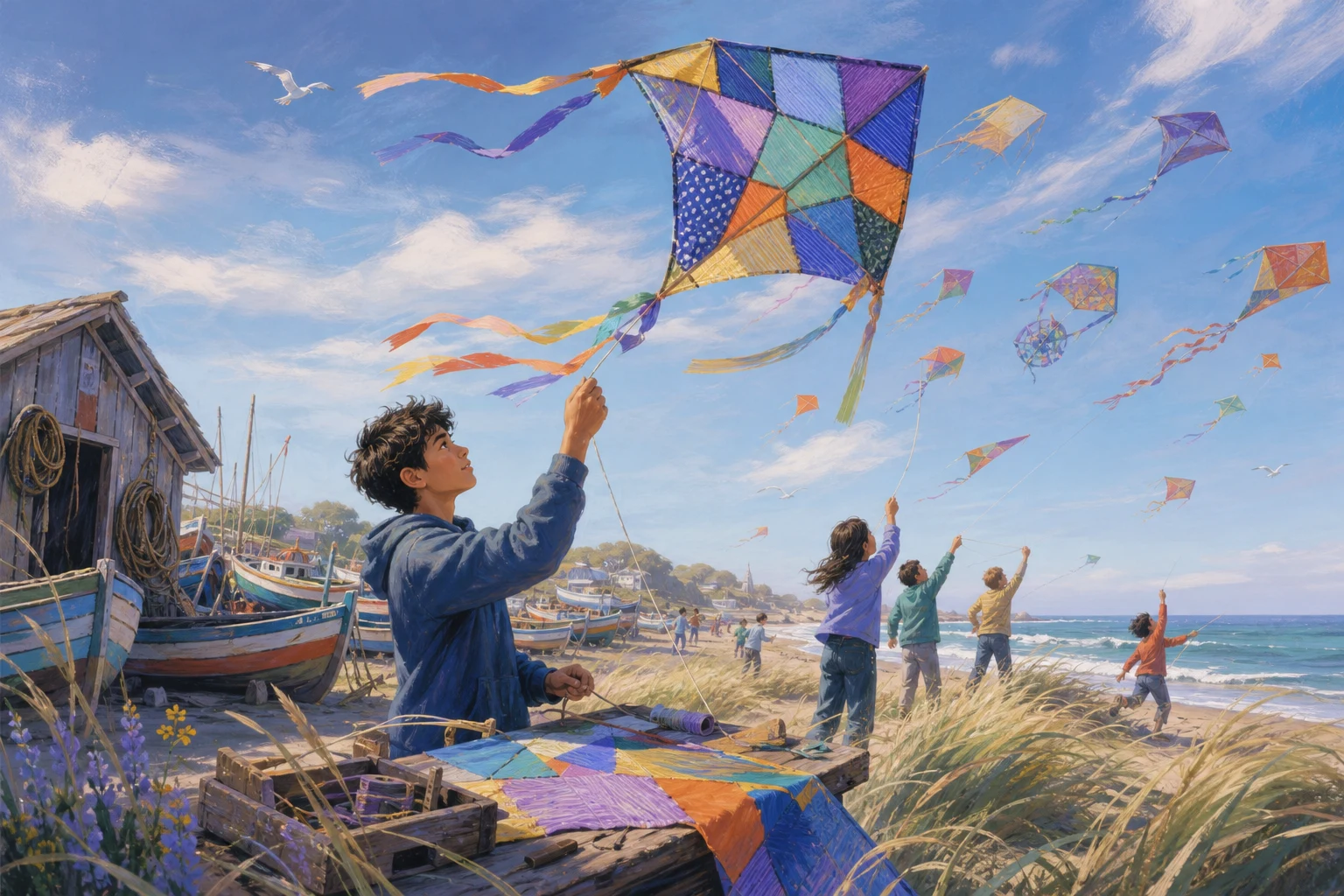
The blue kite split down the middle just as Ilya reached the end of the pier.
One moment, its silver tail was climbing above the painted boats. The next, the frame snapped, the paper cracked, and the whole proud machine fluttered into the tidal grass.
Ilya stood very still while the wind dragged the broken kite toward the rope sheds.
“Beautiful landing,” called Sela, who was eight and never wasted an opportunity to be unhelpful.
“It wasn’t landing,” Ilya said. “It was flying.”
“Then it needs practice.”
Ilya gathered the pieces and carried them home. For three weeks, he had measured bamboo ribs, boiled flour paste, and stitched the longest tail anyone in the village had seen. The regional kite gathering was five days away. His design was meant to fly higher than every other kite on the coast.
Instead, the wind had found its weakness in less than a minute.
That afternoon, Ilya spread the ruined kite across the floor of his mother’s net-mending shed. He inspected every tear. The center was too heavy. The tail pulled unevenly. The frame resisted the gusts rather than bending with them.
Outside, someone laughed.
Ilya looked through the open door. Sela and three younger children were crouched beside the shed, making kites from his discarded paper. Their designs were small triangles and crooked diamonds, held together with knots that looked more suited to tying lunch bundles than flying machines.
Yet when they released them, the little kites rose steadily above the grasses.
Ilya watched one wobble, dip, and recover.
“What did you do to that knot?” he asked.
Sela shrugged. “I tied it until it stopped coming undone.”
The next morning, Ilya brought out his bamboo strips.
“Try a wider frame,” he told the children. “And leave the tail shorter.”
“Will you make ours win?” asked a boy named Toma.
“No,” Ilya said. “I’ll help you make them stay up.”
They worked along the tidal flats, where wind-shaped grasses hissed and fishing boats knocked softly against their moorings. Ilya showed them how to test one change at a time. Sela discovered that a bent crosspiece made her kite turn in circles. Toma found that three loose knots held better than one tight knot. Another child covered a tear with a strip of sailcloth painted bright yellow.
Every mistake became a new shape.
Ilya began cutting his great kite into smaller sections. He used the strongest bamboo for a broad central frame and offered the remaining paper to anyone who wanted it. Soon the children were painting messages on the scraps: safe journeys, full nets, warm bread, a good nap, and one enormous red fish that Toma insisted was “a promise, not a picture.”
On the morning of the gathering, Ilya carried his rebuilt kite to the beach. It was no longer sleek. Its paper was patched with green, yellow, and orange, and its tail held small painted flags made by the children.
The contest judge examined it.
“Unusual,” she said.
“It bends now,” Ilya replied.
The launch began at noon. Across the sand, elaborate kites rose like painted sails. Ilya’s climbed well, but not highest. A narrow crimson kite soared above it, followed by a white one shaped like a gull.
For a moment, disappointment tightened Ilya’s throat.
Then the children released theirs.
One by one, the small kites lifted into the wind. They dipped and steadied, dipped and steadied, until the sky above the village filled with bright, stubborn color. Their strings crossed in a loose web over the beach, and every painted message flashed whenever the sun broke through the clouds.
Ilya’s kite held the center. It did not lead the sky. It gave the others room around it.
When the prizes were announced, Ilya did not win the height contest. He received a special ribbon for design, though he liked the paper sign Sela tied to his handle better. It read: FOR HOLDING EVERYTHING TOGETHER.
That evening, the children stored their kites in the net shed. Ilya labeled a shelf “strong frames,” another “interesting failures,” and a third “ideas not tried yet.”
Sela studied the last label.
“Tomorrow,” she said, “we should build one that flies sideways.”
Ilya looked toward the darkening water, where the wind moved over the waves in long silver lanes.
“Tomorrow,” he agreed, “we’ll need more string.”
Related Quote Stories

Lines the River Remembers
Elian’s first mural was beautiful, ambitious, and missing nearly everyone who used the lane. The second began with a question.
Read Story →
Lanterns Find Their Light
When glare erases her shadow-puppet show, Nadiya must choose between defending her perfect design and inviting others to remake it with her.
Read Story →
A Manual for the Moving World
Belen could fix an elevator by listening to its silence. Teaching someone else required her to explain the noise.
Read Story →