
Quote Stories
A Clearer Way Home
Omi discovers that welcome can begin with a signal everyone understands.
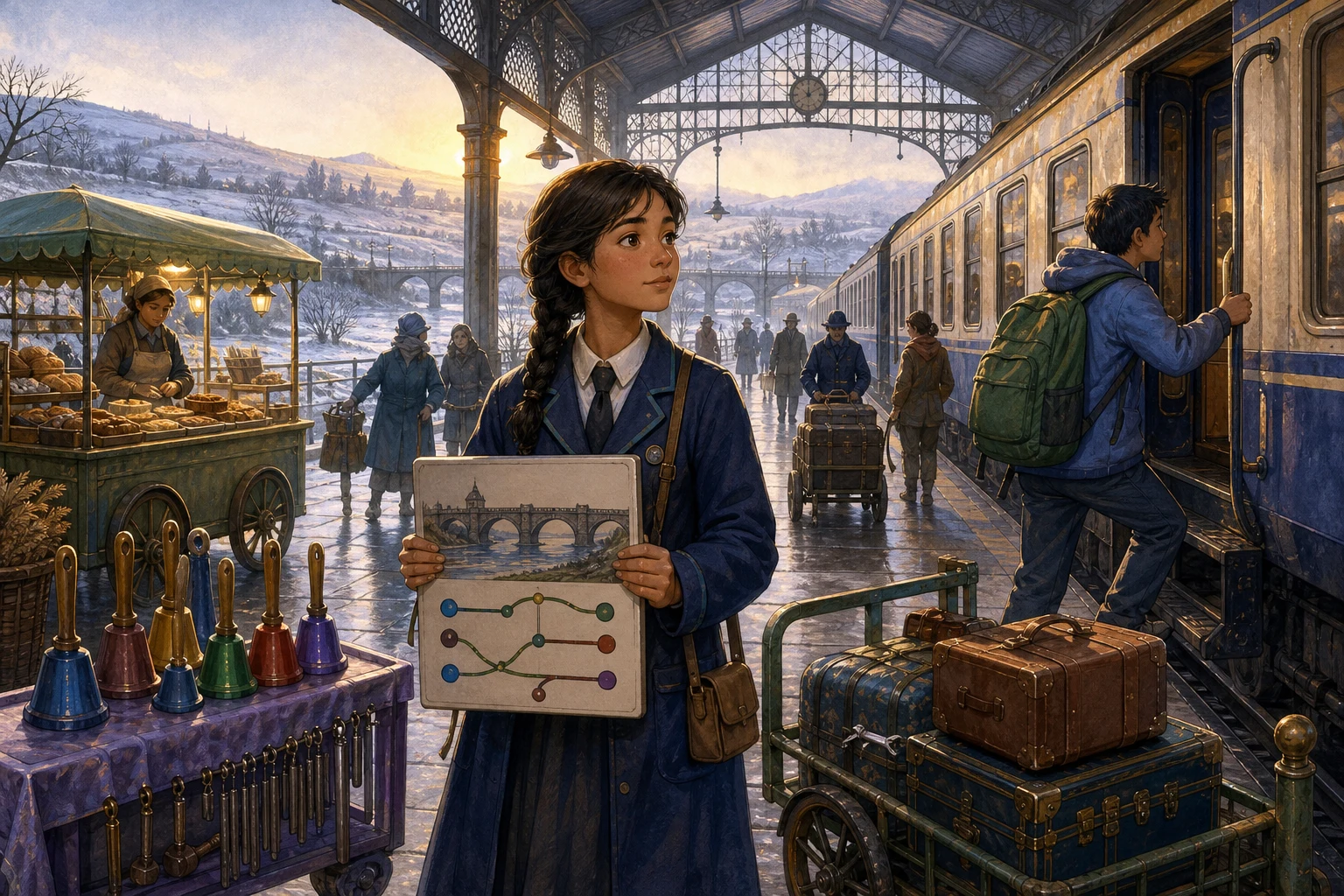
The ticket punch jammed halfway through a paper ticket.
Omi held it up to the morning light. A tiny brass tooth had bent sideways, refusing to do its one job.
“Even machines need instructions,” she muttered.
Platform Four was already filling. Luggage carts rattled over the paving stones. The bakery trolley sent warm cinnamon and cardamom into the chilly air. Beyond the roof, the first trains slid between fields silvered with frost, carrying farmers, nurses, students, and workers toward towns scattered along the inland line.
At 7:18, the school train sighed into the station.
A boy with a green backpack ran toward it, stopped, turned, and stared at the signs. The loudspeaker crackled three announcements in quick succession. He hurried onto the nearest carriage just as the doors closed.
Omi noticed the blue sticker on his notebook: Northfield School.
That train was going south.
She found him ten minutes later beside the parcel office, looking at a timetable as if it were written in steam.
“You need the 7:31,” Omi said. “Platform Two.”
“I thought this was Platform Two.”
“It is Platform Four.”
He looked up at the great iron number hanging above them. “Oh.”
His name was Tavi. He had arrived from a farming settlement beyond the eastern hills and had begun school that week. Every morning, the announcements came too fast. The platform numbers echoed under the glass roof. By the time he understood one train was leaving, another had arrived.
Omi decided the answer was a better timetable.
That evening, she covered her kitchen table with paper. She drew lines for every route, circles for transfer points, arrows for departures, and tiny boxes for exceptions. By midnight, the timetable had become a magnificent web.
The next morning, she gave Tavi a copy.
He studied it. “Which line is mine?”
“The green one.”
“There are four green lines.”
Omi took the timetable back.
For three days, she watched the station instead of correcting people. She saw a woman carrying twins follow the crowd without reading anything. She saw a baker remember trains by the smell of the morning ovens. She saw a conductor tap his pocket twice before checking the departure board. She saw younger students count platform lamps rather than numbers.
Most of all, she noticed that people listened differently.
Some watched. Some read lips. Some waited for the vibration of a train before looking up. Some understood only after hearing an announcement repeated slowly.
Omi brought her observations to the station pianist, Mr. Vale, who played a battered upright piano near the waiting hall.
“What if each school route had its own sound?” she asked.
“Then I hope none of them is the piano being dropped down the stairs,” he said.
Together, they tested three chimes: a high pair for Northfield, a low single note for the southern route, and three bright notes for the eastern villages. Omi painted matching circles on small boards and asked the conductors to hold them up before boarding began.
The first trial was a disaster.
A luggage cart blocked the blue board. A porter rang the chime twice by accident. Mr. Vale played the eastern signal while practicing a waltz. Half the passengers followed the wrong color, and one sleepy man boarded a train carrying a sack of turnips.
Omi wanted to hide beneath the ticket counter.
Instead, she asked everyone what had gone wrong.
The conductors suggested larger symbols. The students asked for colored strips along the platform railings. The bakery workers offered to repeat the signals near the entrance. Tavi pointed out that the boards needed pictures as well as colors because not everyone saw colors the same way.
Omi drew a simple bridge for Northfield, a sun for the southern route, and a wheat stalk for the eastern villages. She placed the symbols low enough for children to see and high enough for luggage carts to miss.
The following Monday, the station tried again.
At 7:24, Mr. Vale played two clear notes. The bridge board rose above the crowd. A strip of green light appeared along Platform Two. The conductor repeated the destination slowly, then paused.
No one ran.
Tavi checked his notebook, matched the bridge to the board, and climbed aboard. Before the doors closed, he turned and gave Omi a solemn thumbs-up.
The system did not make the station silent. Trains still groaned. Carts still rattled. The loudspeaker still occasionally swallowed a word. But people had more than one way to understand what was happening.
A week later, Omi repaired her ticket punch with a narrow brass shim. Then she labeled the drawer where the spare parts belonged—not with a complicated inventory, but with a picture of a hand, a gear, and a question mark.
Mr. Vale saw it and smiled. “Instructions for everyone?”
“For whoever needs them,” Omi said.
Outside, the school train gave its two bright chimes. Across the platform, passengers looked up together, each finding the signal in a form they could follow.
Related Quote Stories
After the Lights Went Out
When a blackout threatens Tomas’s festival order, the guarded baker must trust the students he once turned away.
Read Story →
Bellwork After Supper
Mara’s first timetable lasted three days. Her second had pockets, crooked arrows, and a place for whatever someone knew how to do.
Read Story →
A Manual for the Moving World
Belen could fix an elevator by listening to its silence. Teaching someone else required her to explain the noise.
Read Story →