
Quote Stories
A Seat Between Departures
Omi discovers that help works best when it has somewhere to return.
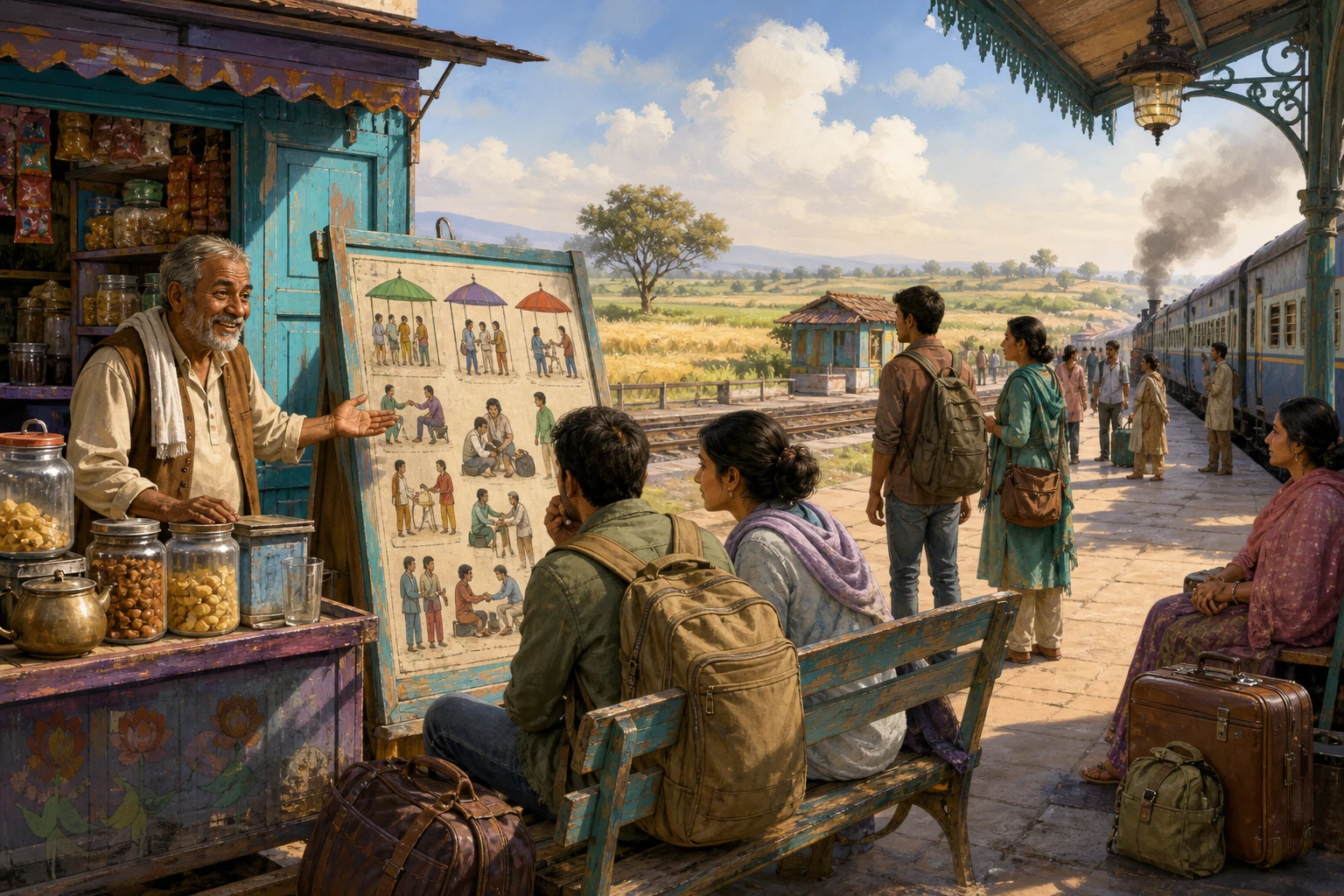
At 11:40, Omi watched a man sprint across the footbridge with one shoe untied and a paper ticket clenched between his teeth.
He reached the stairs just as his train sighed away.
“Platform Nine?” he asked, breathless.
“Platform Nine has gone to sleep,” Omi said. “Sit down before you join it.”
Her kiosk stood between the luggage lockers and a row of potted grasses that trembled whenever a train passed. Travelers often waited there for hours, changing lines across the inland junction. Some slept on their bags. Some stared at the departure board as if patience might alter it.
The next morning, Omi carried a narrow wooden bench from her storeroom and set it beside the kiosk. She painted a small sign: REST HERE. ASK IF NEEDED.
At first, people used it exactly as intended. Then someone left a note beneath the sign.
NEED DIRECTIONS TO THE NORTHBOUND PLATFORM.
Another appeared by lunch.
HAS ANYONE SEEN A PAIR OF READING GLASSES?
By evening, there were six notes, including one that read, PLEASE TALK TO ME ABOUT ANYTHING.
Omi answered what she knew and ignored what she did not. But the notes multiplied faster than she could sort them. One claimed the late train had arrived. Another sent a family toward the freight yard. A third requested a blue suitcase that had never existed.
“This bench has become a rumor with legs,” Omi muttered.
A soft voice behind her said, “Rumors need an editor.”
It belonged to Arun, a college student who bought the same sesame buns every Thursday and usually looked as though he hoped not to be noticed. He offered to type the notes into a list on his phone. Omi recruited Mara, a retired carpenter who repaired the bench’s loose slat, and the station cleaners, who knew every corridor better than the signs did.
Together they made a board with four painted sections: DIRECTIONS, FOUND ITEMS, SMALL FAVORS, and COMPANY. Every note needed a time, a name or mark, and confirmation from someone who had checked it. Unconfirmed information went into a crooked yellow box labeled NOT YET SURE.
The board did not make the station quiet. It made the noise useful.
A porter found a missing inhaler. A nervous traveler learned which footbridge had an elevator. Two strangers waiting through a six-hour delay played cards beneath the company heading. Omi began keeping spare spectacles in a tin, not because she expected to solve every problem, but because someone always seemed to need a clearer view.
Then, one wet Tuesday, Omi received a message from home. Her younger brother had fallen ill, and she needed to reach a clinic several hours away before nightfall. The journey required two trains, a long walk, and a bus she had never taken.
“I’ll close the kiosk,” she told Arun. “I can manage.”
He looked at the board. “You taught everyone to check before they trust a note.”
“I taught everyone not to make a mess.”
“You taught us both.”
Within ten minutes, Mara had found a replacement vendor for the afternoon. A cleaner copied the train connections. A porter marked the safest route through the bus terminal. Someone from the company section offered to walk Omi to the first platform, and a woman whose glasses had been found in the yellow box pressed a wrapped bun into her hand.
At the clinic, Omi arrived before visiting hours ended. Her brother was tired but smiling, and the doctor said the treatment could begin that evening.
When Omi returned two days later, the bench had been polished. Its repaired slat gleamed pale against the older wood. On the board, beneath the four painted sections, Arun had added a fifth:
CAN HELP WITH.
Omi read the heading twice.
Then she took the chalk and wrote beneath it: “Good tea. Better directions. Terrible singing.”
Arun added, “Excellent emergency snacks.”
The station bell rang. Travelers lifted their bags and turned toward different platforms. For once, Omi did not watch them leave with the feeling that every journey had to be managed alone. Some routes crossed because someone had made room for a seat—and because, eventually, someone else had stayed to save it.
Related Quote Stories
Light Between Floors
When the laundry room lights keep failing, an apartment electrician stops replacing bulbs alone and starts building confidence instead.
Read Story →
Ink Along the Waterway
Rina thought repainting the market lane meant making everything match. Then a missing blue heron sent three people the wrong way.
Read Story →
A Route with Room to Change
Ansel trusted his timetable more than almost anything. Then a singer who worked irregular shifts showed him that a route could be dependable without being rigid.
Read Story →