
Quote Stories
Names Beneath the Leaves
Sela learns that a garden can hold more than one kind of knowledge.
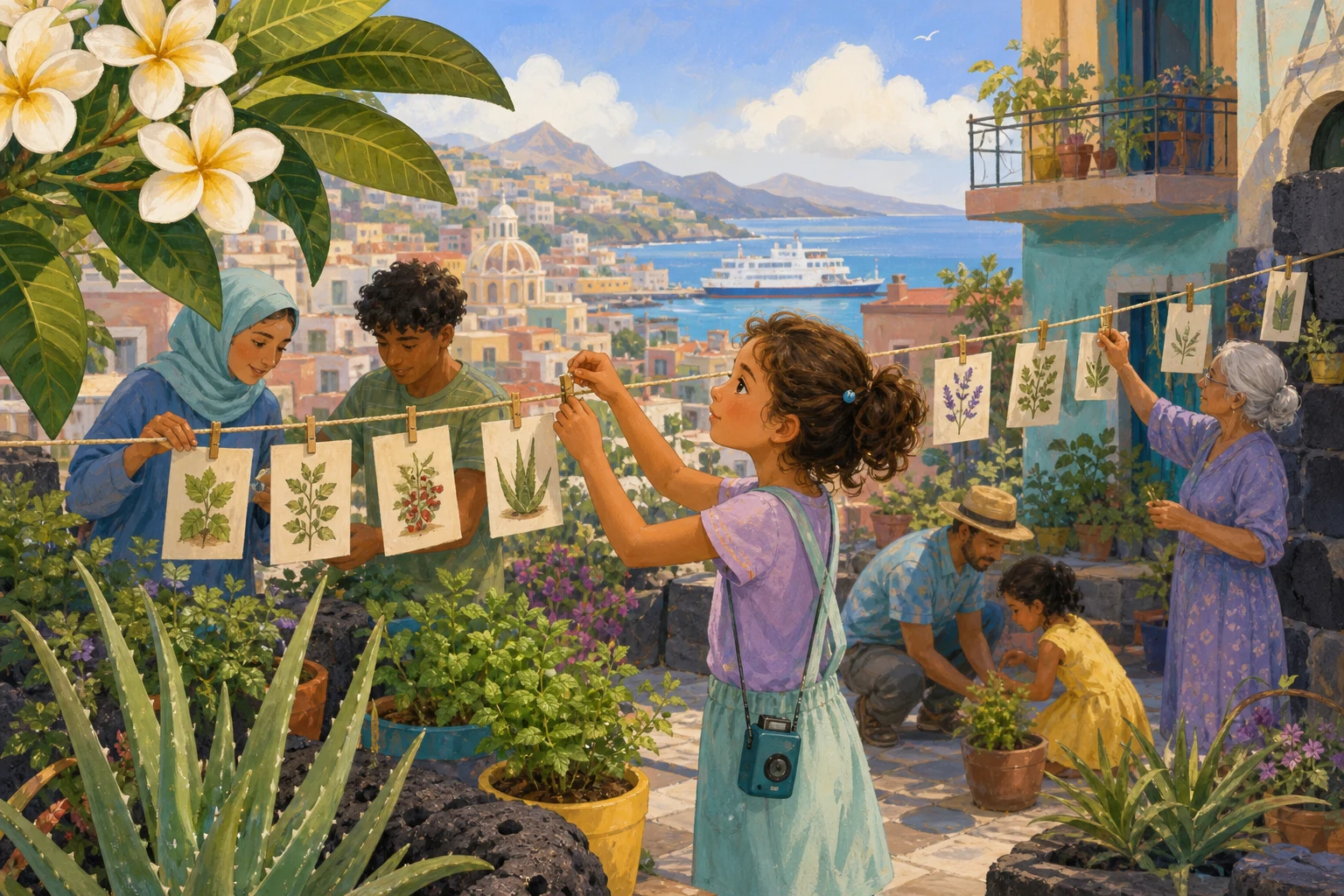
The first sign disappeared before breakfast.
Sela found its empty string dangling from the frangipani branch, turning gently in the courtyard wind. Below it, the plant’s white flowers had dropped onto the volcanic-stone path like little stars.
She hurried upstairs to show her grandfather the other labels: MINT—AROMATIC HERB; ALOE—SUCCULENT; BOUGAINVILLEA—ORNAMENTAL CLIMBER. Each card was written in her neatest block letters, with facts copied from books in the library.
“Maybe the wind took it,” Grandfather said.
But by lunchtime, three more were gone.
Sela watched from the balcony as Mrs. Anik swept the courtyard. The woman paused beside the aloe, touched one thick leaf, and slipped a label into her apron pocket.
Sela ran downstairs. “Why did you take them?”
Mrs. Anik looked startled. “I thought they were notices.”
“They explain the plants.”
“Plants can be explained?”
Sela opened her mouth, ready to recite the aloe’s uses. Then Mrs. Anik added, “My mother kept aloe beside her kitchen door. She used it when my brothers burned their hands cooking.”
Sela’s fact suddenly seemed very small.
That afternoon she found Mr. Pavo watering the mint. He told her he had brought a cutting from a ferry port years ago, wrapped in a damp cloth. The mint had survived three moves and now grew beside his window. A tenant on the second floor showed Sela a pepper plant whose seeds came from her aunt’s island. The caretaker remembered which tree had been planted when the building opened.
Sela began carrying a small recorder instead of a stack of cards.
At the library, she played the conversations for Ms. Imani, the school librarian. Together they drew leaves, flowers, balconies, cooking pots, ferry boats, and listening ears. They made a guide with short sentences and picture clues, then translated each plant’s name with help from residents who spoke different languages.
The work took two weeks. Sela learned to ask permission before recording. She learned that some people wanted their names included and others preferred “a neighbor.” She learned that a plant could be medicine, a memory, an ingredient, a gift, or simply the prettiest thing visible from a window.
On the afternoon of the courtyard gathering, Sela pinned the guide to a clothesline between two balconies. The pages fluttered in the sea breeze. Beside each picture she left a blank card.
At first, nobody wrote anything. Then Mrs. Anik added, “Aloe: for burns, and for remembering my mother.” Mr. Pavo wrote the mint’s journey in three careful lines. Children drew the pepper plant with flames around it. Someone contributed a recipe. Someone else corrected Sela’s spelling.
Grandfather stood beside the frangipani, holding the missing sign.
“I found this behind the water tank,” he said. “What should it say?”
Sela looked at the blank card. Around her, neighbors were talking, translating, laughing, and leaning close to read one another’s words.
She handed him a pencil.
“You tell me,” she said.
He wrote slowly: FRAGRANCE AFTER RAIN. MY WIFE PLANTED IT HERE.
Sela tied the card beneath the flowers. When the wind lifted it, the whole courtyard seemed to answer—not with one explanation, but with many voices making room for one another.
Related Quote Stories
Make Room on Channel Seven
Ilya wants to make the neighborhood station flawless. Instead, a retired dispatcher and a hesitant baker teach him that the best broadcast is not the loudest one, but the one that leaves room for everyone.
Read Story →
Where the Current Slows
Amara’s first conversation circle had all the warmth of a waiting room. Her second began with a bent bicycle bell, a stubborn knot, and someone laughing hard enough to forget the lesson.
Read Story →
Letters in Their Own Weather
Mara can make any letter look important. What she must learn is how to make it sound like the person who meant it.
Read Story →