
Quote Stories
The Pace We Carry
A relay runner learns that finishing together can be its own kind of victory.

Devika’s bicycle was faster than the runners.
She leaned it against the fence at Prairie Bend Recreation Ground, tightened her laces, and studied the relay map taped to the registration table. Four quarter-mile legs. Four handoff zones. One finish line beneath the old grain elevators.
She had not entered a race in eleven years.
“Team Juniper?” called a volunteer.
Devika raised her hand. Her teammates gathered around: Malik, who jogged with a cheerful limp after an old ankle injury; Jo, a university student who could sprint beautifully for half a block; and Peter, a careful beginner wearing shoes so new they squeaked.
“I’m Peter,” he said. “Just so everyone knows, I may be the slow part.”
Devika smiled too quickly. “We’ll find a rhythm.”
What she meant was: We’ll find my rhythm.
During practice, she set the pace. Malik fell behind on the path beside the allotment gardens. Jo missed the turn beneath the sunlit underpass. Peter arrived at the exchange line several seconds late, breathing hard and staring at the baton as if it had betrayed him.
The team lost the handoff.
Devika spun around. “You have to be ready before the runner arrives.”
Peter’s face tightened. “I was trying.”
On her bicycle ride home, Devika replayed the moment. She had wanted the race to prove that her confidence had returned. But confidence, she realized, was not the same as being right.
The next morning, she brought chalk, a roll of bright tape, and a notebook to practice.
“Let’s stop training like four people sharing one stopwatch,” she said. “We’ll build the race around the handoffs.”
They marked shorter practice routes, including the smoothest path for Malik and the widest turns for Peter. Jo learned to slow her final approach instead of bursting into the exchange zone. Peter practiced receiving the baton while walking, then jogging, then running the last few steps.
Devika changed too. She stopped shouting split times and began calling out useful things: “Your shoulders are loose.” “Ten steps to the line.” “I’m here.”
By race morning, a dry wind had swept the clouds from the prairie. Grain silos shone beyond the recreation grounds, and bicycle bells chimed along the wide lanes as spectators arrived.
The fastest teams surged ahead immediately. Juniper did not. Malik completed his leg with a steady, determined stride. Jo took the baton and held back just enough. Devika watched Peter waiting in the marked zone, his knees trembling.
“Look at me,” she called.
He did.
“Three steps, then reach.”
Peter reached. The baton landed in his hand.
For a moment, he ran as though surprised to find himself moving. Then his arms settled into a rhythm. Devika ran beside the boundary fence, not coaching now, just keeping him company.
At the final turn, Jo and Malik were waiting. The four of them entered the last stretch together, not in a line but in a loose, uneven cluster—different strides, shared direction.
They finished behind nearly every team.
They also finished with every runner crossing the line together.
Peter bent over, laughing between breaths. “Was that slow?”
Devika looked at the four sets of footprints pressed into the dusty path.
“It was ours,” she said.
Afterward, she unlocked her bicycle but did not ride away. The team sat beneath the grain elevators, passing around orange slices and comparing the race map. Peter had already circled the date of the next relay.
Devika folded the map and slipped it into her courier bag. She still wanted to run faster. She simply no longer mistook speed for the whole journey.
Related Quote Stories
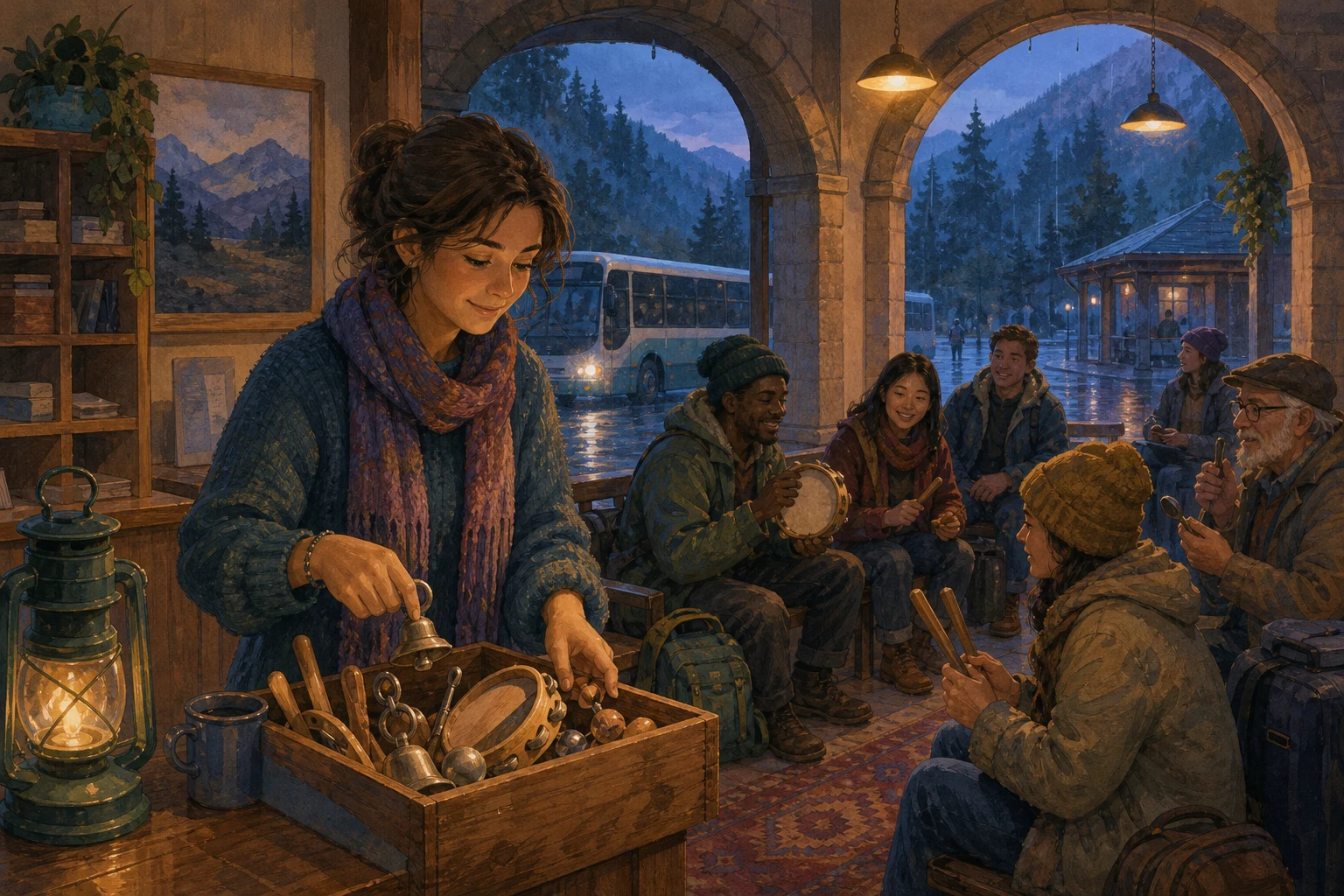
A Rhythm for the Waiting Room
When evening buses stall beneath the mountain pass, ticket clerk Amara offers travelers a box of simple instruments—and learns that making room matters more than making noise.
Read Story →
Before the First Whistle
Nabil knew every lane by its depth, every tile by its crack, and every regular by the sound of their kick. What he did not know was how many people were waiting for a schedule that made room for them.
Read Story →
A Garden Tuned by Hand
When Safiya inherits a nearly silent bell workshop, she plans to sell its molds and move on. A teacher’s request—and a determined group of young testers—leads her toward a new kind of craft.
Read Story →