
Quote Stories
Tide Lines
Hana learns that leadership can begin before anyone calls you captain.
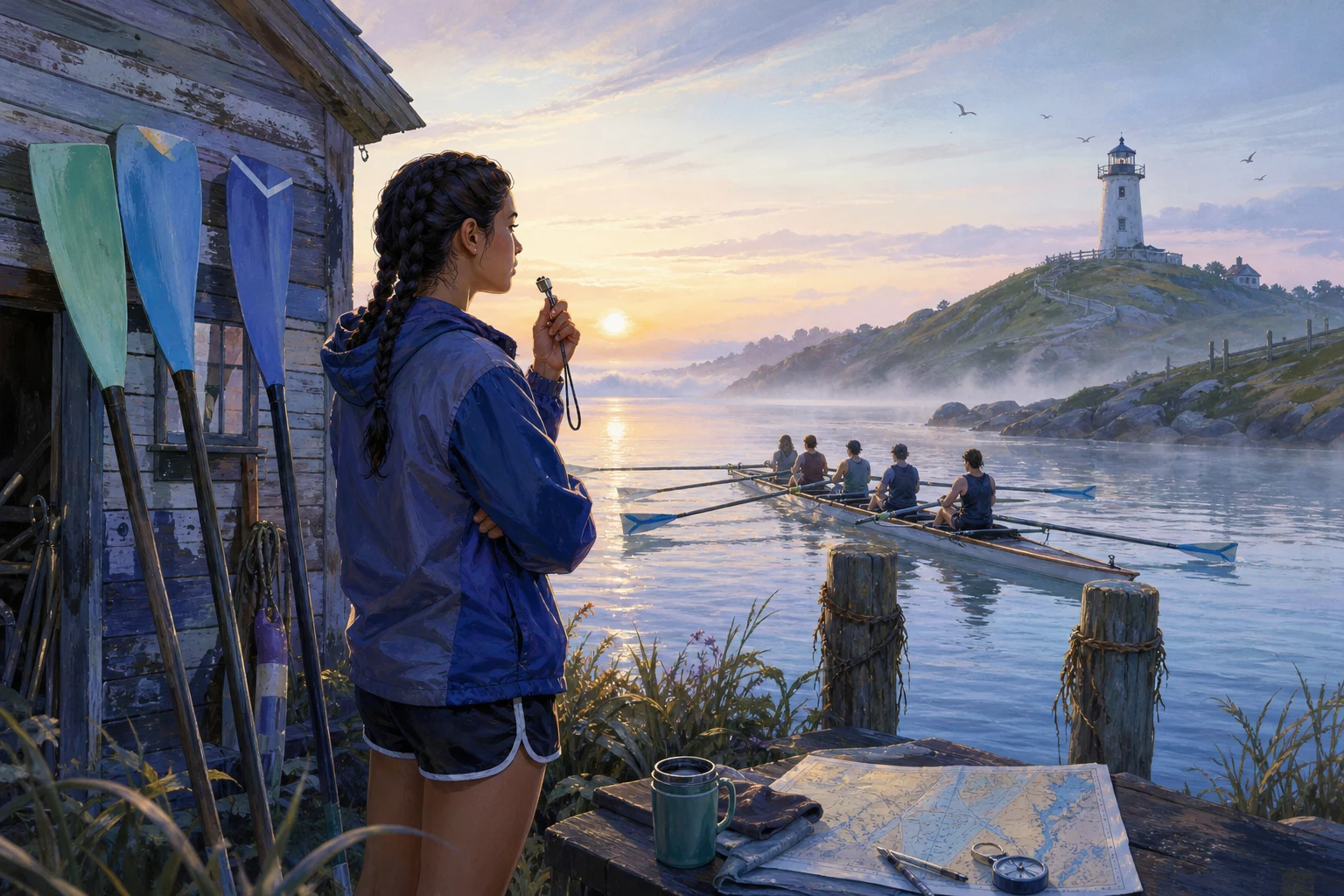
The oar slipped from Hana’s hands and struck the water hard enough to splash the rower behind her.
“Again,” called Coach Iven from the dock.
Hana pulled, pushed, and tried to match the others. Their boat lurched forward, then twisted sideways. By the time they reached the buoy, the crew was arguing about whose fault it was.
On land, Hana could carry two oars under each arm and stack the heavy boats without help. On the water, strength only made the mistakes larger. After three practices, Coach Iven assigned her to equipment duty.
“You’re reliable,” he said. “We need that.”
Hana heard only the part he had not said: You are not ready.
She began spending afternoons in the geography room, where Mr. Sato kept tide charts pinned beside the windows. He showed her how currents curled around the inlet and how wind arriving over the lighthouse path could change the water’s surface.
“The tide doesn’t make every boat move the same way,” he said. “You have to notice what it is doing.”
That gave Hana an idea.
The next morning, she drew a line in the sand beside the boathouse. The newer rowers stood on one side. Hana clapped a steady rhythm while they stepped across together. If someone rushed, the line filled with footprints. If someone listened, the prints formed a clean pattern.
“It’s not rowing,” said Jun, the smallest member of the club.
“No,” Hana replied. “It’s learning when your movement affects everyone else.”
They practiced with buckets, then with short lengths of rope. Nobody had to climb into a boat or be embarrassed in front of the older rowers. Gradually, the group began to hear the difference between moving together and merely moving at the same time.
A week before the novice race, the weather changed. A hard wind swept across the inlet, and Coach Iven announced that the crews would have to use a sheltered route instead of the usual straight course.
The strongest crew struggled first. Their powerful strokes fought the sideways current. Jun’s crew, using Hana’s rhythm, entered the narrow channel carefully. Their boat rocked, but each rower waited for the next person’s movement before pulling.
Coach Iven looked toward Hana on the dock. “You made those drills?”
“With help from Mr. Sato.”
“And why are you not in that boat?”
Hana glanced at the crew. Jun was calling the rhythm now, his voice trembling but clear.
“I think they need to finish what they started.”
On race day, Hana carried the oars down before sunrise. Mist lay over the inlet, turning the lighthouse into a pale smudge. She was not racing, but her stomach still tightened when the boats lined up.
The starting horn sounded.
The crews surged forward. One boat pulled ahead immediately, but the crosswind caught it near the bend. Jun’s crew stayed compact, following the sheltered water and each other. They finished second by less than a boat length.
There was no disappointment in their faces. They had reached the line together.
Coach Iven handed Hana a spare whistle. “Next season,” he said, “you’ll choose where you sit.”
Hana looked at the boat, at Jun still calling the rhythm, and at the tide sliding quietly beneath the dock.
“Maybe,” she said. “But I’d like to keep the drills, too.”
Related Quote Stories

A Map Made by Moving Feet
When a desert wind ruins Sami’s perfect mural, he stops drawing for people and starts watching where they want to go.
Read Story →
What the Fire Left Behind
After a kiln ruins forty-eight bowls, Eren finds an unexpected use for every warped one—and a new reason to keep teaching.
Read Story →
When the Shadows Learned to Sing
A failing theater lantern sends Niko scrambling for a solution—and teaches him that the best performances are built with many hands.
Read Story →