
Quote Stories
When the Shadows Learned to Sing
Niko discovers that a stage can shine without looking the way he expected.
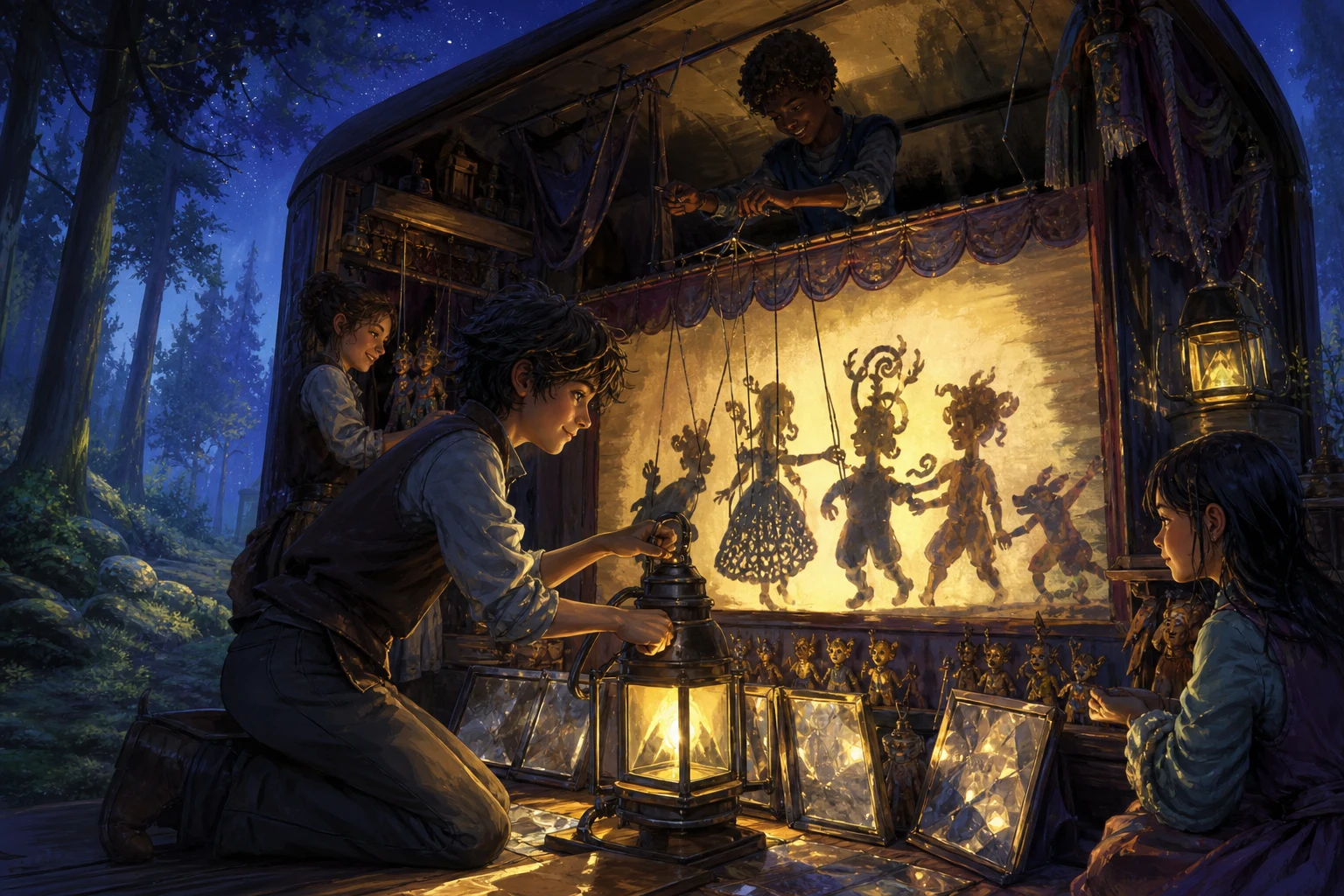
The lantern above the puppet stage went dark just as the dragon opened its painted mouth.
A collective gasp rose from the mossy clearing. Then the dragon vanished.
Behind the canvas screen, Niko grabbed the lantern’s handle. It was warm, smoky, and useless. Across the narrow backstage wagon, his sister Leda was tightening the strings of the moon puppet, already dressed in her silver-threaded sleeves.
“Don’t touch anything,” she said.
“I can fix it.”
“Niko—”
But he had already lifted the lantern from its hook.
The traveling theater had reached the edge of Pineglass Village that afternoon, after three days of rattling wheels, muddy paths, and rain that seemed determined to soak every costume. Tonight was the troupe’s final performance before winter. Tomorrow, Leda would leave to join a larger theater in the eastern cities.
Niko had imagined this last show perfectly. He would stand beside Leda, learn every movement of her hands, and prove that he was ready to inherit her place as the troupe’s next puppeteer.
Instead, the lantern coughed smoke into his face.
He unscrewed the cap, pulled the wick higher, and shook the oil reservoir. The flame leaped up, flared blue, and went out. Niko tried a second lantern. Its glass chimney cracked in his grip.
The audience murmured beyond the screen.
“Wonderful,” said Bram, the drummer. “The dragon has discovered darkness.”
Niko wedged the broken lantern behind a trunk. “No one saw.”
Leda looked at the cracked glass, then at him. Her expression was not angry, which somehow felt worse.
“How many are working?” she asked.
“Two. Maybe three.”
“And how many do we need?”
Niko glanced through a gap in the canvas. The moon puppet waited in the wings. The bird puppets hung from their rods. The painted forest stood ready to become night.
“All of them.”
“Ask the show what it needs.”
“I know what it needs.”
“Then ask everyone else.”
She handed him the moon puppet and stepped toward the stage.
Niko found Bram first. The drummer pointed to the silver cloth used for the river scene.
“Hang it behind the lamps,” he said. “It throws light farther.”
Mara, who kept the costumes, suggested turning the pale undersides of the dragon’s wings toward the lamps. The stagehands brought hand mirrors from the wagon’s repair chest. Old Fen, who painted scenery, remembered a set of polished tin plates used years ago for a storm effect.
None of the ideas solved everything. Together, they made something else possible.
They removed the dead lanterns and placed the working lamps low along the front edge of the stage. They stretched reflective cloth behind the trees. They set the tin plates at angles and assigned two people to turn them gently whenever the puppets moved. Bram changed his drumming so the turning had a rhythm: three soft beats for the left mirror, two for the right.
Niko mapped the light with a stub of chalk on the wagon floor. The moon needed silver cloth. The dragon needed the tin plates. The river could borrow the glow from the lantern near the musicians.
Then the wind rose.
It pushed beneath the canvas roof and sent the cloth billowing like a sail. One mirror toppled. A lamp guttered. Someone in the audience laughed nervously.
Niko’s hands began to shake. He had wanted to be the person who knew what to do. Instead, he had broken glass, delayed the show, and turned a simple problem into a maze of ropes and shadows.
Leda found him crouched beside the lamp table.
“You don’t have to make it look like my show,” she said.
Niko stared at the chalk marks. “I wanted to be ready when you left.”
“You are ready to begin.”
She tied the loose corner of the reflective cloth to a wagon wheel. “Beginning is rarely tidy.”
From the stage came Bram’s signal: three soft beats.
Niko stood. He called for the mirror. Mara held the dragon’s wings open. Fen lifted the tin plate. The lamps glowed against the silver cloth, and the puppet’s shadow stretched across the screen—larger than before, bright-edged and trembling with every careful movement.
The dragon returned.
This time, the audience did not gasp because it had disappeared. They gasped because it seemed to breathe fire made of gold.
The rest of the performance became a conversation among light, music, cloth, and hands. The moon rose in a wash of reflected blue. The painted river shimmered whenever Bram struck the rim of his drum. During the final scene, Niko turned a mirror too far, and a bright oval of light landed on a pine tree beyond the stage. Children in the front row reached toward it, laughing.
After the applause, the troupe gathered beneath the trees. Leda gave Niko the chalk he had used to draw the lighting plan.
“Keep it,” she said.
He looked at the smudged lines. “It’s not finished.”
“Good.”
Behind them, the lamps cooled one by one. Their glow faded from the canvas, but not before Niko noticed how many shadows had helped make the dragon visible.
In the morning, Leda left with the eastern road.
Niko stayed with the troupe, not as her replacement, but as the person responsible for asking what the next show needed—and listening for all the answers.
Related Quote Stories

A Map Made by Moving Feet
When a desert wind ruins Sami’s perfect mural, he stops drawing for people and starts watching where they want to go.
Read Story →
What the Fire Left Behind
After a kiln ruins forty-eight bowls, Eren finds an unexpected use for every warped one—and a new reason to keep teaching.
Read Story →
Tide Lines
Hana wanted a place in the boat. Instead, she found a way to help everyone move together.
Read Story →