
Quote Stories
Routes Drawn in Pencil
A bus-terminal guide becomes better when everyone gets to correct it.
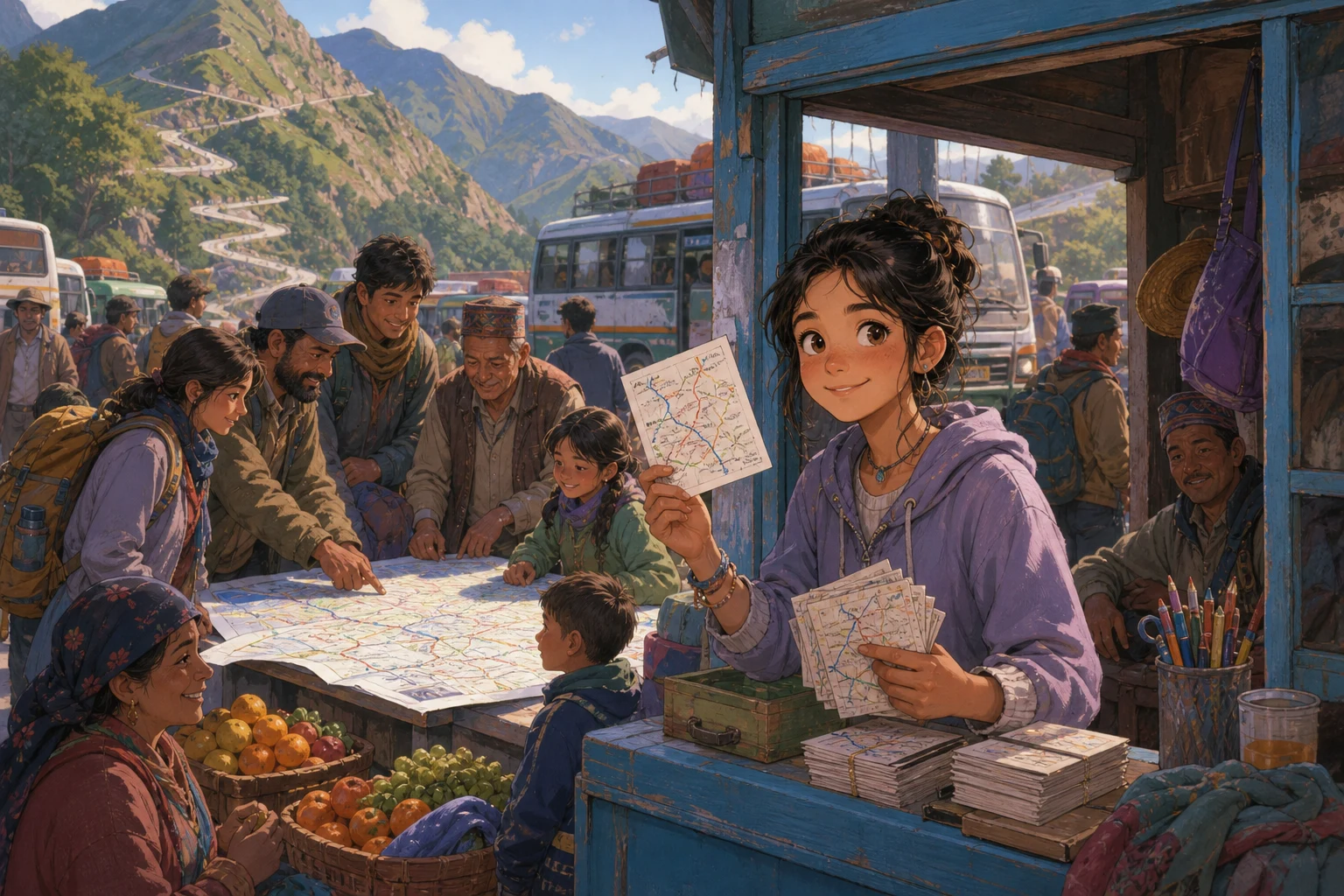
The first route card sent a traveler toward a bakery, a goat pen, and a locked garden gate.
Suri discovered this when the traveler returned twenty minutes later, carrying the same red suitcase and a very patient expression.
“Platform Four?” he asked.
Suri looked at the card in his hand. Her drawing showed a bridge, a blue roof, and an arrow bending neatly uphill. The bus terminal had installed a bright electronic timetable that morning, but its scrolling letters changed too quickly for many passengers to follow. So Suri had decided to make paper guides herself, using thick lines and little pictures: a bell for the market, a painted water tank for the upper guesthouses, a row of yellow fruit stalls for the road toward the border.
She had not expected the mountain to object.
“I’m sorry,” she said. “The bridge is farther down.”
Her grandmother, who ran the luggage booth beside the terminal, leaned over the counter. “And the blue roof?”
“A chicken shed.”
“Useful landmark,” Grandmother said. “Less useful destination.”
Suri frowned. She had wanted to prove she could solve the timetable problem without bothering anyone. Instead, her first cards led people into wrong turns, dead ends, and once, according to a laughing bus driver, directly behind the public washhouse.
That afternoon, she took a stack of cards to the drivers’ rest area.
“Show me where I’m wrong,” she said.
A driver named Bako traced one of her arrows with a blunt fingernail. “This road looks straight on paper. It is not straight in life. Put a bend here.”
A fruit seller added, “The yellow stalls move when the morning bus arrives. Use the stone lion near the steps.”
A woman traveling with two sleepy children suggested drawing the steep stairway as a ladder. An elderly porter pointed out a shaded shortcut that Suri had never noticed because she always hurried past it. A guesthouse cook explained that visitors called the same hill by three different names.
Suri rewrote the cards that evening at the luggage booth while buses groaned up the switchback road. She erased the cleanest lines first. The new version had more bends, more symbols, and a small blank space at the bottom labeled: “Ask if the road has changed.”
The next morning, she tested it herself. She followed the card from the terminal to the upper guesthouses, carrying a borrowed suitcase so she would notice where wheels caught on stones. At the first fork, she found that a new tea stall blocked the landmark she had drawn. At the second, a landslide had narrowed the path.
By lunchtime, Suri had another correction to make.
This time, she did not feel defeated. She felt invited.
She placed a pencil beside the cards at the booth and asked people to mark anything confusing. Some drew arrows. Some added words in languages Suri could not read, then asked another traveler to translate them. Children colored the landmarks. Drivers began bringing back cards with small notes tucked inside.
At the end of the week, the terminal manager cleared a space beside the electronic timetable for a large guide assembled from everyone’s revisions. It showed the platforms, the market, the clinic, the guesthouses, the border road, and the safest places to ask for help. Suri drew the main lines, but she left the corrections visible in different colors.
Grandmother studied the finished guide. “It is not very tidy.”
“No,” Suri said. “But it gets people there.”
A bell rang at Platform Four. Passengers reached for their bags, checked the guide, and began moving together through the crowded terminal. Suri watched a traveler stop, turn the map around, and offer it to someone who looked uncertain.
For once, she did not hurry to explain. She let the guide do what it had learned to do: make room for another person’s knowledge.
Related Quote Stories
Rows That Remember Rain
Oren trusted numbers, neat columns, and the quiet certainty of a closed notebook. Then a child asked him a question his records could not answer.
Read Story →
The Minute Between Trains
Irena had repaired the station clock three times, and three times it had kept perfect time. The trouble was not the clock. It was everything around it.
Read Story →
A Map Made by Moving Feet
When a desert wind ruins Sami’s perfect mural, he stops drawing for people and starts watching where they want to go.
Read Story →