
Quote Stories
Hinges in Winter
A locksmith discovers that useful knowledge becomes brighter when more hands can hold it.
The brass key stuck halfway in the lock, exactly as Anja expected.
She leaned her shoulder against the shed door until the frozen wood gave a tired groan. Inside waited her aunt’s tools, arranged in dusty rows: files, awls, drills, coils of wire, and a coffee tin labeled SMALL SPRINGS. The place smelled of iron, pine shavings, and the sharp cold that crept beneath every door in January.
Anja had come to empty it.
By Saturday, she planned to post a notice in the market square: SHED CLOSED. TOOLS FOR SALE.
Then someone knocked.
A woman stood outside holding a garden latch wrapped in a wool scarf. “Your aunt repaired this three times,” she said. “It belongs to my mother’s gate.”
“I’m sorry,” Anja replied. “I’m not taking work.”
The woman looked at the locked door. “Could you show me how to do it, then?”
Anja almost said no. Instead, she unwrapped the latch.
The repair took eleven minutes. The woman watched closely, asking only two questions. Before leaving, she placed a jar of cloudberry jam on the workbench.
The next morning, three more objects appeared outside the shed: a shovel with a split handle, a child’s mitten clasp, and a hinge bent nearly flat. No one had left a note.
Anja repaired the hinge. She replaced the clasp. She stared at the shovel for a long time before finding a strip of birchwood that would fit beneath the handle.
That afternoon, she wrote instructions on a scrap of cardboard and pinned them to the door. She used large drawings instead of sentences: a cracked handle, two arrows, a strip of wood, four nails.
The following day, the cardboard had been copied in blue pencil.
A quiet child stood beside the door, holding the drawing. Anja recognized her from the market: a nine-year-old who rarely spoke and carried a square notebook everywhere.
The child pointed to the picture, then to the shovel, then drew a question mark.
“You want to try?” Anja asked.
The child nodded.
Her name was Lio. She measured the birchwood carefully, tapped each nail twice, and drew a new picture when Anja’s first diagram proved confusing. In Lio’s version, the arrows were thicker, and the hand holding the hammer was shown from above.
“It’s clearer,” Anja admitted.
Lio smiled without looking up.
Soon the shed door filled with diagrams. Old Hessa from the orchard drew a method for straightening wire without snapping it. The brothers who maintained the footbridges demonstrated a clever knot using colored thread. A retired baker brought a tin of tiny screws and stayed to sort them by size.
Anja still intended to close the shed. She told herself that every evening.
Then a hard wind came down from the northern ridge and tore the gate from the community garden. Its hinges scattered across the snow. The garden would remain inaccessible until spring unless someone fixed it.
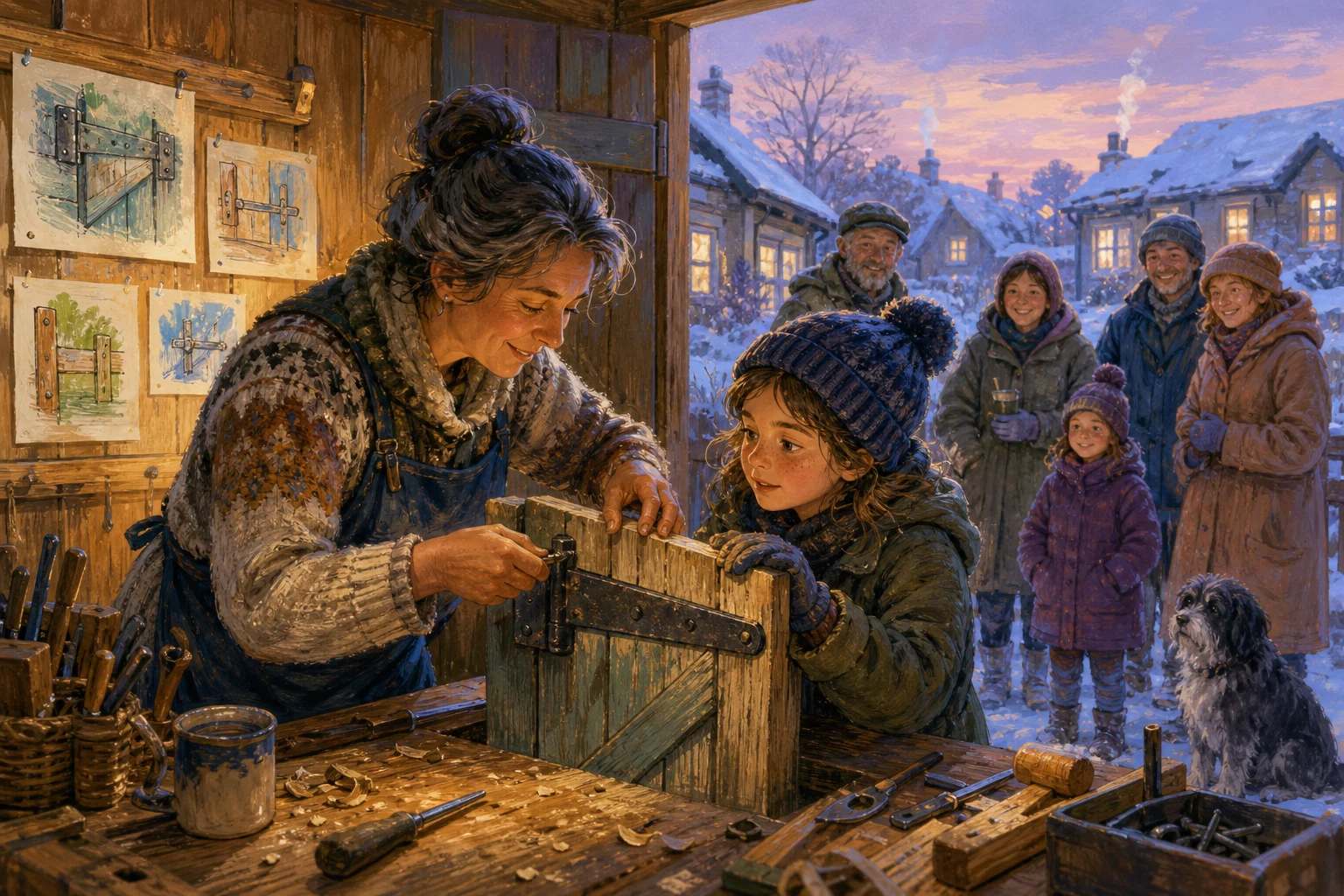
Anja carried the gate to the shed. Lio drew the damage. Hessa supplied a length of old chain. The bridge brothers found sound timber in the back room. Anja cut, drilled, and fitted the pieces while a dozen neighbors watched and offered suggestions.
For the first time, she did not feel as if she were working inside her aunt’s shadow. She was standing in the middle of a circle.
By dusk, the gate swung open. It did not close quietly; one hinge squeaked like a mouse. Everyone laughed when Anja declared the sound acceptable.
The next morning, she took down the closing notice.
In its place, she hung a painted sign: REPAIR YARD. BRING A BROKEN THING. BRING A WAY TO HELP.
Lio added a small blue hinge beneath the words.
Anja kept her aunt’s tools, but changed their arrangement. The sharpest files moved higher. The frequently used tools came within easy reach. Beside the workbench, she built a low table for drawings, sorting, and careful experiments.
Winter continued around them—snow on the orchard branches, smoke above the roofs, footsteps ringing across the frozen bridge. Inside the shed, something was always being loosened, strengthened, reshaped, or passed from one pair of hands to another.
When spring finally opened the garden, its gate still squeaked.
Anja left it that way. It announced, clearly and cheerfully, that someone was coming through.
Related Quote Stories
A Pocketful of Repairs
When a delivery rider brings Mara a jacket held together by mismatched buttons, the retiring tailor begins one last project: teaching the whole district how to mend what still has life in it.
Read Story →
Lanterns Between Currents
Isha measured every delivery in minutes—until the dark paths between the market stalls taught her that getting somewhere mattered less than helping others find the way.
Read Story →
Leave a Little Wall
Iven expected applause for his mural. Instead, he got a list of everything his bright new design had covered—and discovered a better way to finish it.
Read Story →