
Quote Stories
Knots for the Evening Tide
Mina discovers that learning can begin with what people already know.
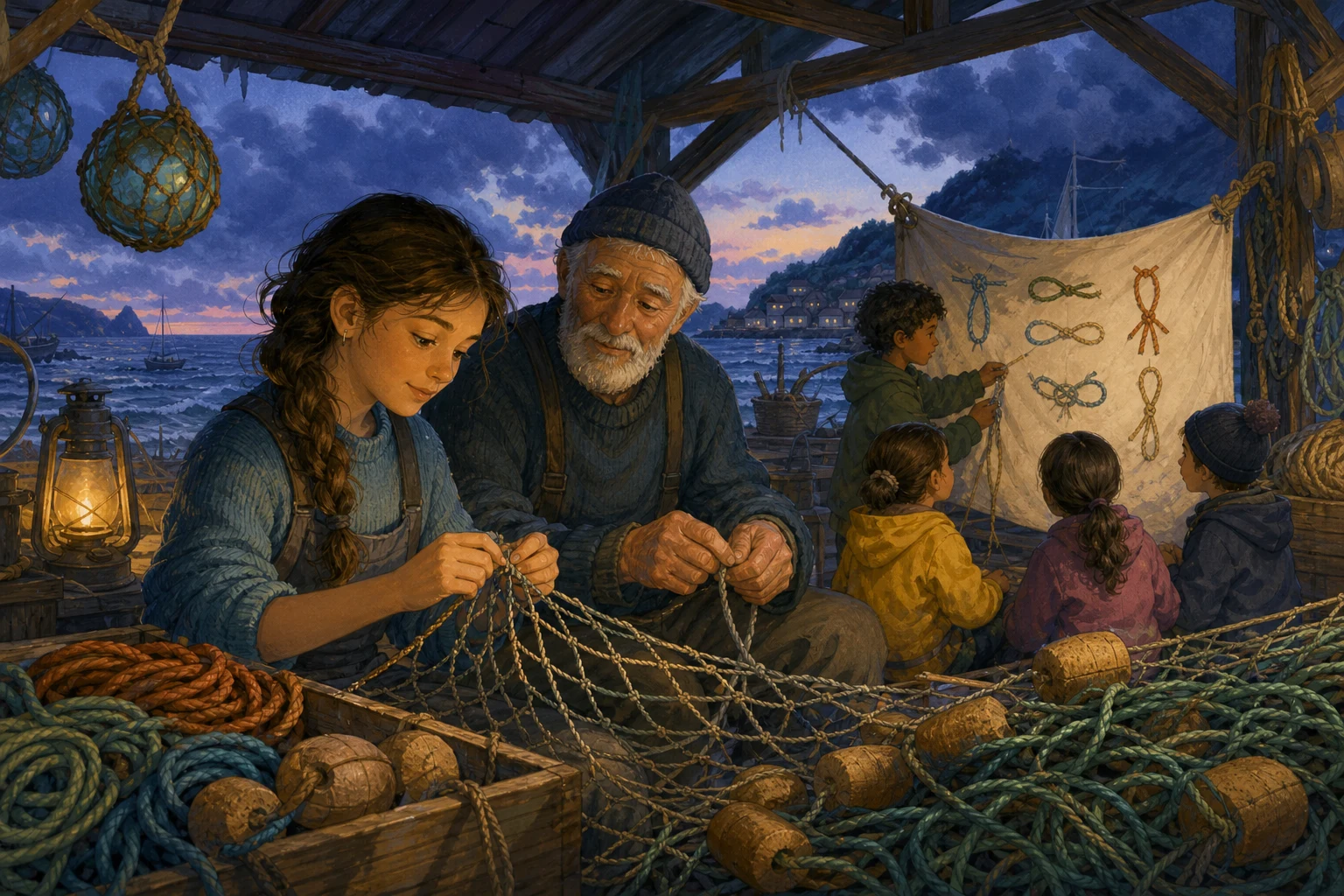
The first knot slipped just as the bell at the harbor tower rang six.
Mina caught the loose cord before the net could spill into the tide pool beneath the shed. Her grandfather looked up from his stool, one eyebrow raised.
“Too much hurry,” he said.
“Too much homework,” Mina replied. “And too many nets.”
Outside, the island was preparing for storm season. Boats were being hauled higher up the beach. Shutters were tested, rope was coiled, and families carried sacks of supplies into wind-bent cottages. The younger children had begun missing lessons to help.
Mina understood. She had spent years learning which threads could bear strain and which only appeared strong. Still, she worried when a neighbor’s eight-year-old brother asked her how to read the numbers on a tide chart.
“Could you show us after supper?” he asked.
Mina glanced at the unfinished net. Then at the darkening water.
“Tomorrow,” she said.
But tomorrow brought another missed lesson, and the next day brought three more children. So Mina cleared a corner of the net shed, hung a lantern from a beam, and wrote STUDY HOUR on a scrap of sailcloth.
The first evening was a tangle. One child wanted spelling words. Another wanted help adding supply lists. Someone kept swinging a coil of rope like a lasso. Mina had planned a lesson about fractions, but no one could concentrate over the clatter of hooks and the smell of wet canvas.
At last, she put down her pencil.
“This isn’t working,” she said.
A small voice came from behind a stack of cork floats. “Maybe the numbers should do something.”
It was Tavi, who rarely spoke in school. He held up a length of cord.
“If we make three loops,” he said, “then divide them between two boats, we can see what half of three means.”
Mina stared at the cord. Tavi showed the others how to tie the loops. The children counted, measured, and argued cheerfully about whether a boat could share a fraction of a loop. When the lesson ended, they had learned more than Mina’s worksheet contained.
The following night, she began with knots.
A fisher explained how to estimate rope needed for a mooring line. Mina turned the estimate into arithmetic. Tavi brought a storybook and matched words to the names painted on the boats. An older girl taught everyone how to read the symbols on a weather map. Even Mina’s grandfather joined in, demonstrating a knot that held fast but opened with one tug.
The hour changed shape each evening. It moved around supper times and boat repairs. On busy nights, it lasted only twenty minutes. On calm nights, nobody noticed when the lantern burned low.
Mina stopped trying to be the only teacher. She made a board with three columns: “I can show,” “I want to learn,” and “We can practice.” Soon the board filled with handwriting of every size.
Then a hard wind arrived earlier than expected. The school closed for two days while families secured roofs and boats. Mina feared the study hour would disappear.
Instead, people carried the lesson into their work. Children read the labels on supply crates. Parents asked them to calculate lengths of rope. Grandfather let Tavi mark the safest knots on a piece of sailcloth. By evening, the net shed was crowded—not with a class waiting for Mina, but with people bringing things to share.
When the school reopened, the younger children returned with damp shoes and wind-tangled hair. They were behind in some lessons, but no longer afraid of the pages. Mina was behind too, in her own assignments. Her teacher frowned at first, then listened as Mina explained the rotating schedule and showed the sailcloth board.
“Could you bring that method to class?” the teacher asked.
Mina thought of the first knot slipping through her fingers. She thought of Tavi speaking from behind the cork floats.
“Only if everyone gets to add a column,” she said.
That evening, the net shed smelled of salt, lamp smoke, and chalk. Mina repaired a torn mesh while Tavi read aloud. Her grandfather counted stitches under his breath. At the end of the table, a child carefully wrote the next day’s tide times.
No one had borrowed an hour from anyone else after all. They had made one by fitting their knowledge together, strand by strand.
Related Quote Stories
Hours on Two Wheels
Pavel opened his bicycle shop before sunrise, expecting customers to bring broken machines. Instead, they brought questions, worries, and time they could offer one another.
Read Story →
What the Broken Notes Were Saying
Daro had replaced the recorder’s cracked mouthpiece twice. It still squeaked like a startled pigeon. The child holding it knew why.
Read Story →
A Calendar for Every Tree
Amaya thought a good seed keeper should notice everything. By midsummer, she had noticed too much to manage alone.
Read Story →